
8 min read
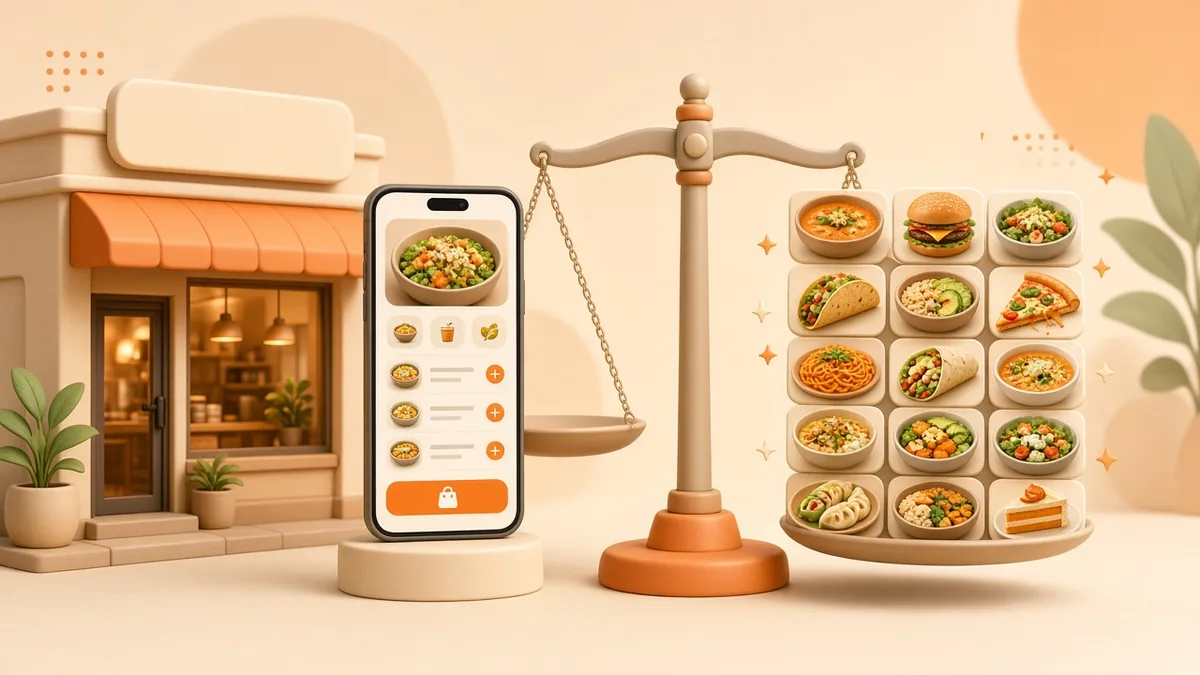
Restaurant groups debate owned ordering apps vs food aggregators constantly. Aggregators bring traffic; owned apps protect margin and customer data—if operations can fulfill promises. This breakdown helps finance and ops align on strategy.
The economics: aggregator vs owned app
Aggregator economics
Commissions and promos can erode margin but accelerate trial. Useful when discovery is the bottleneck.
Owned app economics
Higher upfront investment, better repeat-order economics when loyalty works. Requires marketing to feed the funnel—SEO, social, and SMS—see delivery apps overview.
Finance alignment: contribution margin by channel
Model margin after commissions, promos, packaging, and refunds—per branch and per channel. Aggregator GMV can hide margin destruction if promos stack or if repeat users would have ordered direct.
Owned channels shift spend from commissions to CRM and ads—track blended CAC and payback honestly.
Measuring cannibalization honestly
When you launch owned ordering, some orders will shift from aggregators to direct—that is not automatically “incremental.” Run holdout tests with finance-grade accounting.
When aggregators remain strategically correct
If your brand is new or geographically thin, discovery may still matter more than margin. Use aggregators as a top-of-funnel channel while you build repeat behavior—then convert to owned channels with loyalty that rewards direct orders.
| Food aggregator | Owned app or web ordering | |
|---|---|---|
| Customer acquisition | Built-in traffic | You must drive it |
| Fees | Commissions per order | Build, hosting and payment fees |
| Customer data | Mostly with the platform | Yours |
| Brand control | Limited | Full |
| Best for | Discovery and new customers | Regulars, loyalty and margin |
Operations: kitchens, riders and peak hours
Owned apps still need reliable fulfillment. If riders are third-party, SLAs depend on partners; if in-house, capital and training matter.
Peak hour playbook
Throttle promos, adjust prep-time estimates, and communicate honestly. Users accept slower food when they trust the timeline.
Rider handoff at the curb
Last-mile experience is where reviews are won or lost. Train riders on greeting scripts, hygiene expectations for open food, and escalation when customers are unreachable. Small details compound into brand perception.
Staff training and change management
Owned apps change kitchen workflows. Train staff on pause times, substitution policies, and escalation—technology is only as good as the people operating it.
Staff incentives and fraud
Watch for collusion between riders and kitchen staff on substitutions and refunds. Basic controls and spot audits reduce leakage.
Branding, CRM and loyalty
Branding and CRM
Owned channels personalize offers and recover abandoned carts. Aggregators own the relationship inside their UX.
Loyalty programs: points vs subscriptions vs bundles
Points programs are easy to market but hard to tune—avoid subsidizing users who would purchase anyway. Subscriptions work when frequency is high and operations can honor perks. Bundles lift basket size when kitchen capacity allows.
Marketing: owned funnels need creative discipline
Owned apps do not generate demand automatically. Plan lifecycle campaigns: first-order incentives, win-back offers for dormant cohorts, and branch-specific promos tied to inventory reality.
Data you should own
Owned apps should feed a clean customer record: frequency, favorite items, price sensitivity signals, and support history. That data powers CRM—but only if staff capture accurate reasons for refunds and substitutions.
Integrating feedback loops
Reviews, support tags, and rider notes should funnel into weekly product ops. Patterns in “too salty” or “late rider” comments reveal operational fixes faster than executive intuition.
Menu, product and policy design
Menu engineering for owned channels
Owned apps let you bundle high-margin items, test LTOs without marketplace approval delays, and run CRM-driven win-back campaigns. Design menus for margin, not only top-line GMV.
Product: modifiers, allergens, and substitutions
Food apps live or die on accurate modifiers. Train menus for operational truth—false availability creates refunds and reviews you cannot buy away.
Refund policy design
Clear policies reduce disputes. Train staff to apply them consistently; inconsistent refunds become social media incidents.
Menu photography and truth in advertising
Misleading photos increase refunds and chargebacks. Align creative with what kitchens can produce at peak.
Technology and integrations
Technical implications
Menus, modifiers, promos, and refunds must be modeled cleanly—see food delivery app development Philippines.
Integrate kitchens carefully: order throttling, printer failures, and pause states must propagate to riders. Reconcile payouts nightly—discrepancies explode during peaks.
Choose developers who understand kitchen ops, rider integrations, and reconciliation—not only UI. Ask for references in food, not only generic ecommerce.
Multi-branch, franchise and corporate orders
Franchise and multi-branch complexity
If you operate franchises, owned apps need role-based admin, branch-level reporting, and clear policies for promos that differ by territory. Aggregators simplify discovery but complicate franchise economics when fees vary.
Franchise royalty and promo governance
Franchise systems need clear rules on who can run discounts, how approvals work, and how royalties are calculated when promos reduce ticket size. Ambiguity creates audit fights and broken partner trust.
Your app should encode permissions: branch managers can pause items; regional managers can approve limited promos; headquarters sets guardrails. Logs matter—someone will ask “who approved this?” during a bad weekend.
Corporate accounts and invoicing
B2B ordering introduces credit terms, billing addresses, and approval flows. If this is part of your strategy, model AR collections and support load—not only top-line GMV.
Dark kitchens and virtual brands
Virtual brands can arbitrage discovery, but they add operational complexity. Owned apps help when you can convert repeats—otherwise you are still renting discovery.
Analytics and finance reviews
Analytics you should track
Repeat order rate, promo redemption cost, rider ETA accuracy, and refund reasons—segment by branch and channel. Aggregator dashboards rarely show the full picture your finance team needs.
The finance review rhythm
Monthly: channel margin and refund reasons. Quarterly: promo ROI and cohort LTV by acquisition source. Annually: owned-app roadmap vs marketplace dependency strategy.
Founders who only look weekly at GMV miss the slow leak that kills franchises: rising refunds, rising CAC, and falling repeat without a clear cause.
Operational KPIs for CFOs
Track gross margin after refunds, labor efficiency in kitchens, and rider cost per delivered order. Tie marketing spend to incremental margin, not only to installs.
Customer segmentation
Segment by frequency, basket size, and channel preference. Send different offers to high-frequency lunch users vs occasional dinner users. Personalization increases margin when grounded in data—not vibes.
Sequencing a hybrid rollout
Hybrid playbooks
Many brands list widely but push subscriptions and bundles on owned properties after first purchase.
Sequence, don’t boil the ocean
Many brands start aggregator-first for velocity, then invest in owned ordering once repeat cohorts justify the build. The mistake is building a fancy app before kitchen throughput can handle demand spikes.
Ninety-day rollout plan (outline)
Month one: stabilize aggregator performance and export clean data. Month two: pilot owned ordering in highest-repeat branches. Month three: expand with loyalty experiments tied to measurable margin.
City-by-city execution
Metro Manila’s density differs from provincial cities where rider supply is thinner. Your promos, ETAs, and staffing models should differ too—one national playbook often fails.
Start where you can win weekends consistently. Prove operations, then expand geography with a playbook—not with hope.
Founder pitfalls: vanity apps
An owned app that duplicates aggregator listings without CRM value is expensive branding. Build when repeat cohorts justify it—not when ego demands it.
What to stop doing
Stop blanket discounts. Stop running promos during kitchen failures. Stop measuring success only by app downloads.
SEO: capture high-intent local searches
Publish branch pages, menu pages, and policy pages; interlink with food delivery development and comparisons. Authority compounds when content maps to real operations.
The bottom line
Brand is what remains when promos end. If your quality drops, no CRM can save you. Invest in kitchen consistency, rider courtesy, and honest communication—these are the inputs that make owned channels worth owning.
When you publish content, speak like an operator: explain fees, explain delays, explain substitutions. Users reward transparency with repeat orders—especially in the Philippines where social proof travels fast.
Finally, connect your owned app roadmap to measurable margin outcomes. If a feature does not improve margin, retention, or operational efficiency, defer it. Founders who chase novelty over economics rarely survive the second year.
Fees are lower on an owned channel, but you still carry CRM, refunds, rider handoff, and marketing that matches branch capacity. If the kitchen slips or handoff proof is weak, that is where one-star reviews and refund storms start. Pilot one outlet: watch repeat, margin, and refund reasons before you go national—word of mouth moves fast here.
We help restaurant groups decide when owned ordering is worth the ops cost—and we build apps that survive Friday night volume.
Frequently asked questions
Should my restaurant leave food delivery apps?
Rarely all at once. Aggregators are still useful for discovery. Many restaurants keep them and add owned ordering for regular customers.
What makes an owned ordering app worth it?
Repeat customers, a loyalty reason to order directly, smooth payments and kitchen operations that can handle the extra channel.
What should a restaurant app integrate with?
Your POS or order management, payment gateway, delivery partners and a CRM for loyalty and marketing consent.
