
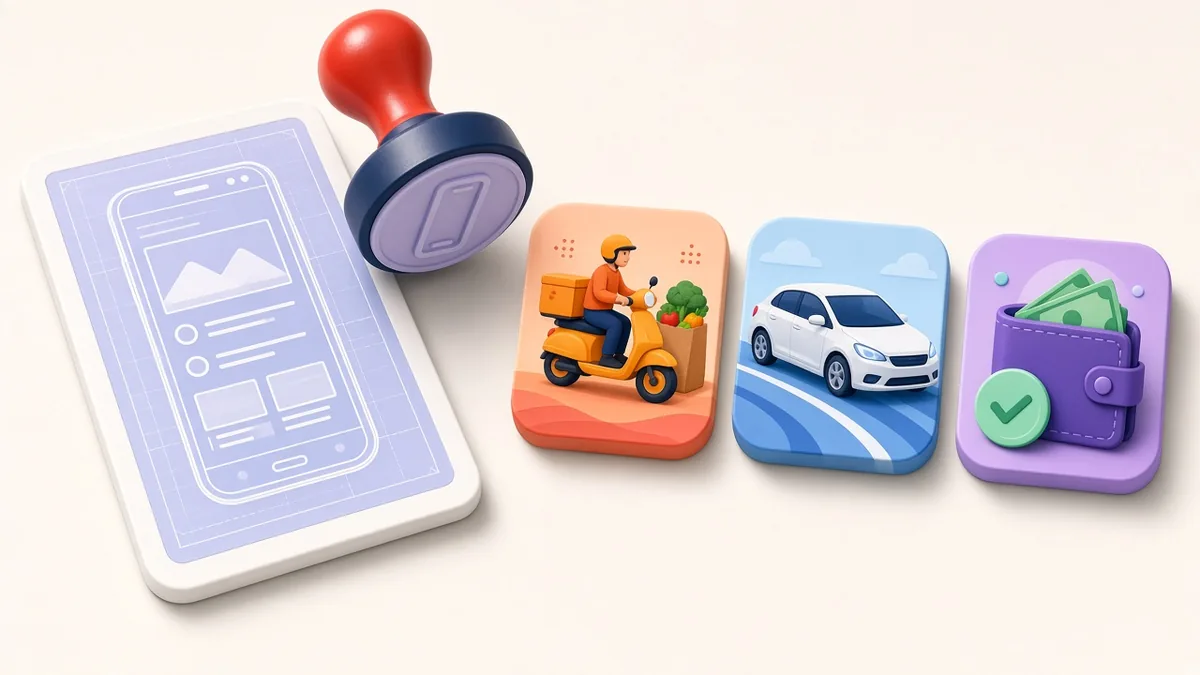
A white-label app is a complete, working app (for example a food delivery, ride-hailing or e-wallet app) that a developer has already built and then rebrands with your business name, logo and colours before publishing it under your own store accounts. It is the fastest and usually the cheapest way to launch a proven app model, often in weeks instead of months. The trade-off is less uniqueness, and you still need to sort out the business side: permits, licences, riders or merchants, and marketing.
This guide explains how white-label apps work, what you can and cannot change, the legal and app store points Filipino entrepreneurs should know, and how to decide whether it is the right route.
How a white-label app works
Most white-label platforms come as a set of connected parts:
- Customer app for placing orders, booking rides or paying
- Provider app for riders, drivers or service providers to accept jobs
- Merchant app or panel for restaurants and stores to manage orders and menus (for marketplace models)
- Admin dashboard where you set fees, approve partners, track operations and view reports
- Backend and database running on a server that connects everything
The developer takes this existing system, applies your branding, configures it for your market (currency, payment methods, service areas), and helps publish the apps on Google Play and the App Store.
White-label vs custom vs clone: what is the difference?
| White-label | Custom build | |
|---|---|---|
| Starting point | Existing, tested app | Blank page and your requirements |
| Time to launch | Weeks to a couple of months | Usually several months |
| Upfront cost | Lower | Higher |
| Uniqueness | Branding and configuration; deeper changes cost extra | Everything designed around your business |
| Risk | Lower technical risk because the core already works | Higher, but you control every decision |
People often use “clone app” to mean the same thing: an app modelled on a well-known service such as a food delivery or ride-hailing platform. A responsible provider builds the functionality, not a copy of another company’s brand. Your app needs its own name, logo and identity.
Types of white-label apps available
ServicioPro’s products page lists ready-made systems including:
- Food delivery (customer, merchant and rider apps)
- Ride booking with parcel delivery
- Handyman and home service booking
- Fintech, credit or lending, and e-wallet style apps
- Multi-service “super app” platforms combining parcel, e-commerce, food, grocery and medicine delivery (5-in-1), with a 6-in-1 version that adds car rental
- Short-video social apps
- School management and hospital management systems
These are listed at ₱100,000 to ₱800,000 depending on the package tier, with turnaround stated as two weeks to two months depending on the app’s functionality.
What you can customise at each level
Using ServicioPro’s food delivery app listing as an example, the three tiers differ mainly in what is bundled:
- White Label (₱100,000): name, colour and logo change, store submission, Firebase, Twilio and SendGrid/Mailchimp integration, PayPal, and the source code. You handle store accounts, payment gateway registration and hosting (listed at ₱1,700 per month).
- Standard (₱400,000): adds PayMongo integration, store account registration, business permit application assistance, logo design, in-app graphics, device testing and one year of hosting.
- From Scratch (₱800,000): adds a new user interface and UX redesign, integration of one local payment gateway (PayMongo, Dragonpay, Maya or GCash) and two years of hosting.
Whatever vendor you use, ask for this kind of written breakdown. The biggest surprises in white-label projects come from excluded items.
App store rules that matter for white-label apps
Apple’s App Review Guidelines (section 4.2.6) state that apps created from a commercialised template or app generation service will be rejected unless they are submitted directly by the provider of the app’s content. In practical terms, your white-label app should be published under your business’s own Apple Developer account, not the developer’s. Apple’s spam rules (section 4.3) also discourage apps that are near-identical copies of what is already on the store, so meaningful branding and content matter.
For Google Play, new personal developer accounts must run a closed test with at least 12 testers for 14 consecutive days before they can apply for production access. Organisation accounts need a D-U-N-S number. Either way, register the accounts early so they do not delay launch.
Licences and permits: the part the app cannot do for you
An app is a tool. Running a delivery, transport or financial business still requires the right registrations. Depending on your model, this can include:
- Basic business registration: DTI (sole proprietorship) or SEC (corporation), mayor’s permit and BIR registration.
- Ride-hailing: transport network companies are accredited by the LTFRB, and motorcycle taxi platforms are covered by separate LTFRB rules that have limited new entrants. Check the current circulars before investing in a passenger transport app.
- E-wallets: issuing electronic money generally requires authorisation from the Bangko Sentral ng Pilipinas as an electronic money issuer.
- Lending: lending companies must be registered with the SEC and hold a certificate of authority, and online lending platforms have their own SEC registration requirements.
- Personal data: every one of these apps collects customer data, so the Data Privacy Act of 2012 (RA 10173) applies.
This is general information, not legal advice. Speak to a lawyer or the relevant agency about your specific business model before launch.
Is a white-label app right for you? A checklist
A white-label app is usually a good fit if you can tick most of these:
- Your business model is common and well understood (delivery, booking, rides, services).
- Speed to market matters more than a completely unique product.
- You have a plan to recruit riders, drivers, merchants or service providers.
- You have a marketing budget; an app with no users earns nothing.
- You are prepared to cover monthly running costs: servers, SMS, maps and support.
- You have checked the permits and licences your model needs.
A custom build is better if your process is genuinely new, if your competitive edge depends on the software itself, or if you need deep integration with existing company systems. Our guide to mobile app development costs in the Philippines compares both routes in more detail.
Questions to ask a white-label provider
- Can I test a demo of every app (customer, provider, merchant, admin) before paying?
- Will I receive the source code?
- Whose developer accounts will the apps be published under?
- Which payment methods are integrated at my tier?
- Who hosts the server, and what does it cost monthly after any included period?
- How are updates handled when Android or iOS changes?
- What changes are included, and how are extra features priced?
Next steps
If you are considering a delivery, booking or fintech app, start by trying the demos and listing what you would change. ServicioPro can walk you through the ready-made options on the products page or scope a custom build through its app development service. Contact us at support@serviciopro.ph or +63 929 647 3840 (WhatsApp, Telegram, Viber).
Frequently asked questions
Will my white-label app look the same as other businesses’ apps?
At the basic tier, the layout will be similar to other apps built on the same base, with your own name, logo and colours. If a distinct look matters, choose a tier or add-on that includes interface redesign.
How long does it take to launch a white-label app?
The build itself can take a few weeks. Allow extra time for developer account verification, Google Play’s closed testing requirement for new personal accounts, payment gateway approval and app store review.
Can I add new features later?
Usually yes, especially if you receive the source code. Additional features are typically quoted separately.
Do I own the app?
You should own your brand, your developer accounts, your data and, ideally, a copy of the source code. Confirm the exact ownership and licence terms in writing before you pay.
