
9 min read
PUV modernization in 2026 is in a holding pattern with clear edges: the original consolidation deadline passed in April 2024, consolidation reopened in 2025 only on routes that were already at least 60% consolidated, a Supreme Court challenge by PISTON remains pending, and new jeepney fares took effect on September 28, 2026. For cooperatives and corporations that did consolidate, the practical question now is how to run a shared fleet well, and that is where digital fleet management helps.
This article has two parts. First, a status check built from Philippine news reports, with dates and labels. Second, ServicioPro’s practical guide to fleet technology for consolidated operators. Nothing here is legal advice; confirm requirements with the LTFRB, DOTr or a lawyer.
Part 1: Where PUV modernization stands
Consolidation: the 2024 deadline
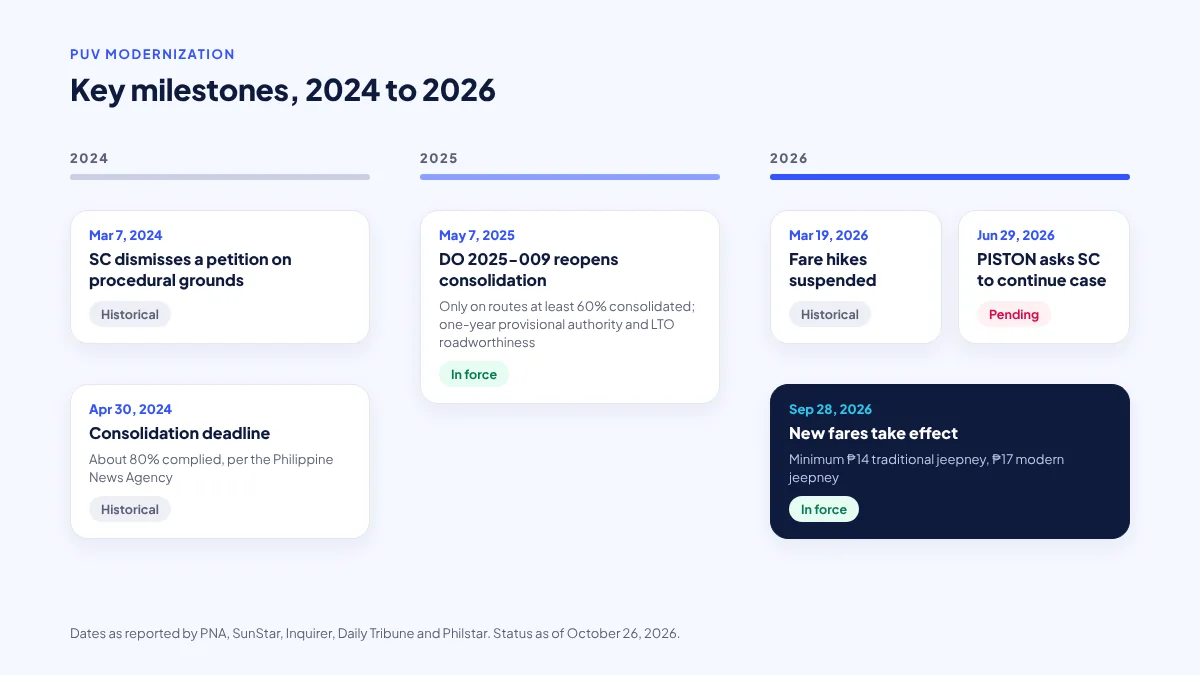
The Public Transport Modernization Program (PTMP) required individual franchise holders to consolidate into cooperatives or corporations. The deadline was April 30, 2024. The Philippine News Agency reported on May 16, 2024 that about 80% had complied. Status: historical.
Before that, on March 7, 2024, the Supreme Court dismissed a petition against PUV modernization on procedural grounds, according to SunStar. Status: historical.
Reopened consolidation under DO 2025-009
On May 7, 2025, the DOTr reopened consolidation applications through Department Order 2025-009, the Inquirer reported. Key conditions as reported:
- Only routes where at least 60% of units had already consolidated.
- A one-year provisional authority for those who consolidate.
- Roadworthiness checks by the LTO.
The PISTON case
On June 29, 2026, the transport group PISTON asked the Supreme Court to continue hearing its challenge to jeepney consolidation, according to the Daily Tribune. No ruling or temporary restraining order had been reported. Status: pending.
Fares: suspended, then in force
Fare increases approved in March 2026 were suspended by the President on March 19 and remained suspended through August. The DOTr lifted the suspension on September 25, and new fares took effect on September 28, 2026, as reported by Philstar. Status: in force.
| Mode | Minimum fare from September 28, 2026 |
|---|---|
| Traditional jeepney | ₱14 |
| Modern jeepney | ₱17 |
| City bus, ordinary | ₱15 |
| City bus, air-conditioned | ₱18 |
Operators must post the updated fare matrix in their vehicles, according to reports.
Franchise administration changes
- In force (May 21, 2026): MC 2026-035 and MC 2026-038 removed newspaper notices of hearing and hearings for compliant franchise renewals. Operators must maintain a valid email address as the official channel, according to AutoIndustriya.
- Proposed (January 23, 2026): a draft to deny franchise renewal to dilapidated PUVs, reported by ABS-CBN News.
- Pending (July 6, 2026): MC 2026-050, banning vlogging or livestreaming while driving a PUV, with a ₱5,000 fine and possible revocation, was being finalised.
What we did not find
We found no 2025 or 2026 news of a new GPS or CCTV mandate for PUVs. On cashless fares, the most recent government pilot in our research is historical: in 2022, the DOTr and Landbank tested EMV card payments on 150 modern PUVs, according to AutoIndustriya. Anyone claiming a new tech mandate should be able to point to a circular.
Part 2: Why consolidated fleets need better tools
Consolidation changed the management problem. An individual operator with one or two jeepneys could run on memory, a notebook and a phone. A cooperative running many units on shared routes has to answer new questions every day:
- Which units are on the road right now, and where?
- Which vehicles are due for maintenance before a roadworthiness check?
- How much did each unit collect, and does it match the trips run?
- Which drivers are assigned to which units and shifts?
- What does the board need to see each month?
Paper and group chats can work at small scale, but they make disputes hard to settle and reports slow to produce. That is where a fleet management system earns its keep.
Consolidation turned many small operators into one organisation. Fleet software is how that organisation sees itself.
The five building blocks of fleet management for co-ops
1. GPS tracking and trip logs
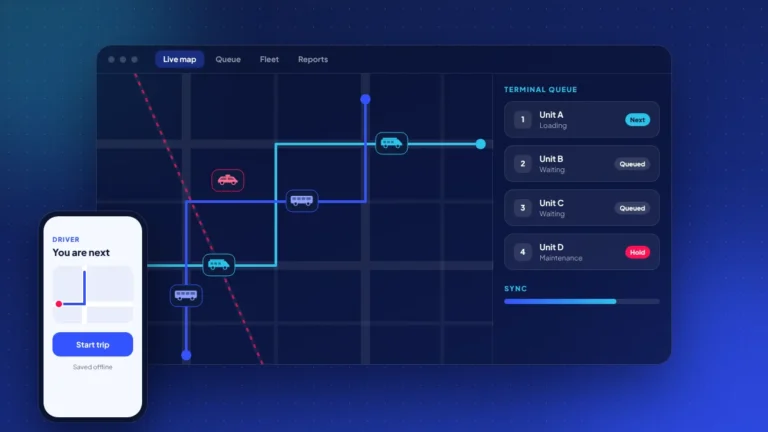
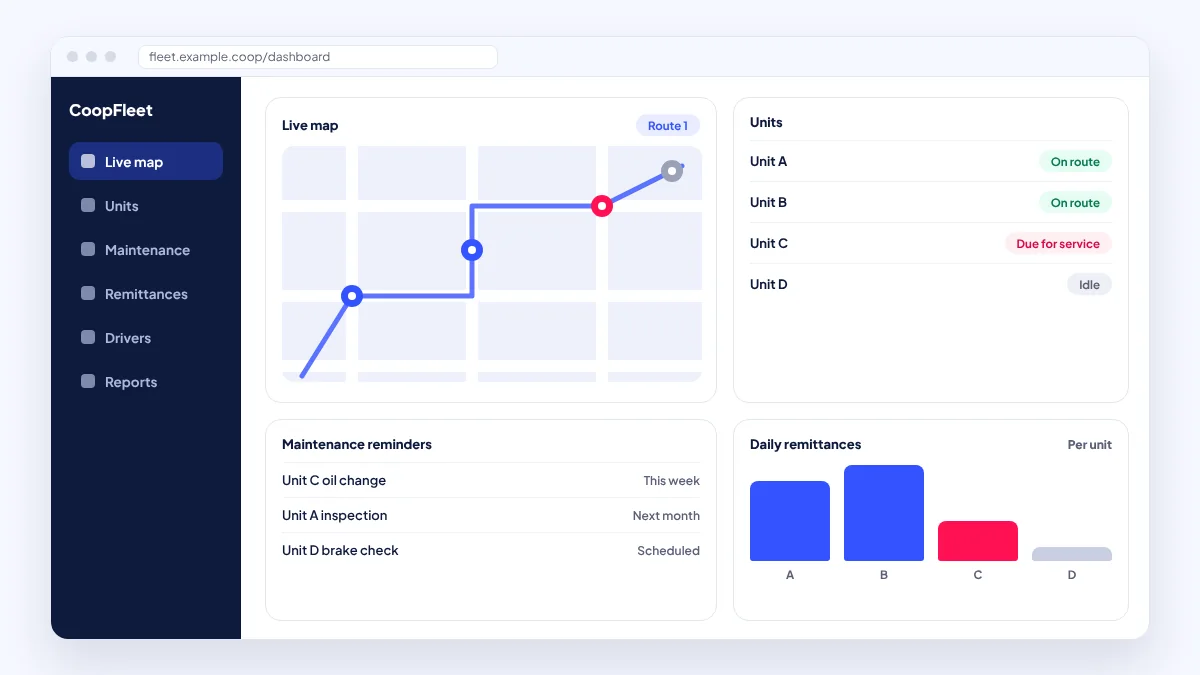
A GPS device or a driver phone app reports each unit’s position. The system turns those positions into trip logs: start time, end time, route followed and stops. Managers see a live map; the board sees service patterns over time. Even without a mandate, trip logs help with route planning and with resolving complaints.
2. Maintenance and roadworthiness records
DO 2025-009 ties provisional authority to LTO roadworthiness, and a draft LTFRB policy would deny renewal to dilapidated units. A maintenance module tracks service intervals, parts replaced and inspection dates per unit, and sends reminders before something lapses. It also builds a documented history, which is useful if a unit’s condition is ever questioned.
3. Fare collection and reconciliation
Cash remains common on jeepneys, so the starting point is often a simple daily remittance log per unit and driver. Cashless options are growing in the wider economy: BSP data reported by the Daily Tribune shows digital payments reached 64.7% of retail payment volume in 2025, with QR Ph overtaking cards. A co-op can pilot QR Ph payments on a few units before going further. When fares change, as they did on September 28, the fare table in the system should be updated on the same day.
4. Driver and shift management
Assign drivers to units and shifts, store licence details and expiry dates, and record incidents. Tie this to the trip logs so remittances, hours and routes line up per driver.
5. Reporting for the board and members
Cooperatives answer to members. Monthly reports on units in service, trips, collections, maintenance costs and incidents make governance easier and reduce suspicion. Reports should be generated from the system, not retyped.
| Building block | Problem it solves | Simple starting point |
|---|---|---|
| GPS and trip logs | Not knowing where units are or how routes run | Driver phone app with location sharing |
| Maintenance records | Missed services and failed inspections | Per-unit service schedule with reminders |
| Fare reconciliation | Disputes over remittances | Daily remittance log per unit and driver |
| Driver management | Expired licences, unclear assignments | Driver profiles with expiry alerts |
| Board reporting | Slow, manual monthly reports | Auto-generated monthly summary |
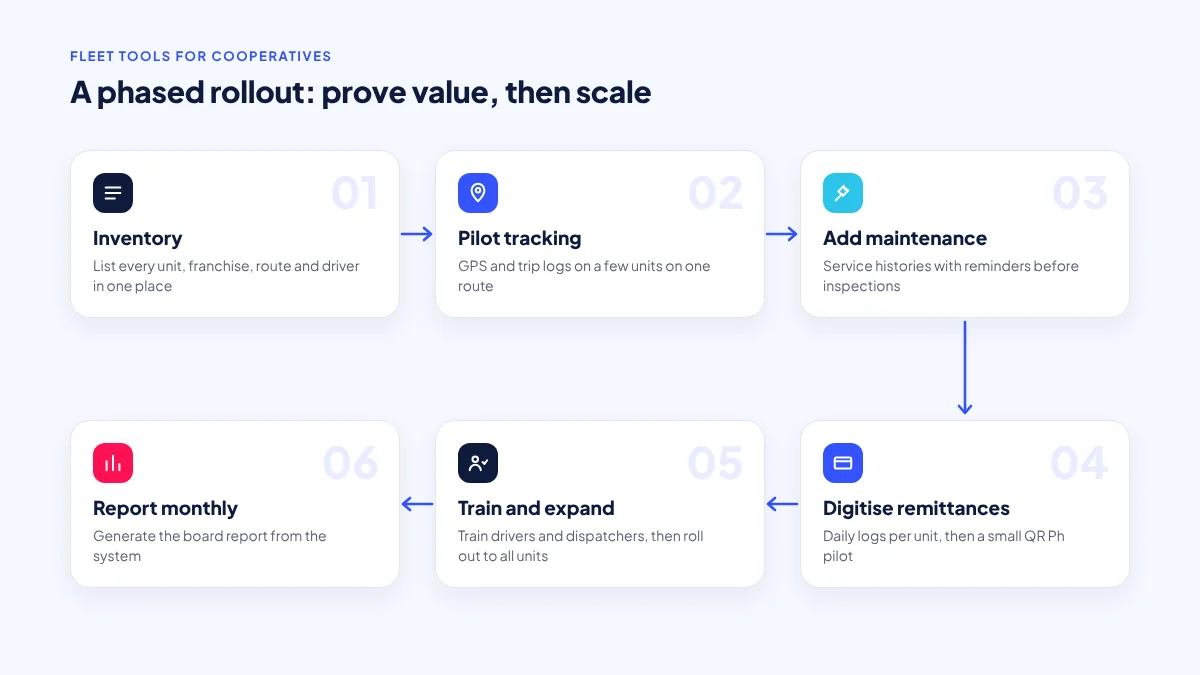
A phased rollout plan for cooperatives
This is ServicioPro’s recommended sequence. It keeps cost and disruption low by proving value before expanding.
- Inventory. List every unit, franchise, route, driver and current maintenance status in one place. This alone often reveals gaps.
- Pilot tracking. Start GPS and trip logs on a few units on one route for a month. Check data quality and driver acceptance.
- Add maintenance. Load service histories and set reminders ahead of inspection dates.
- Digitise remittances. Replace notebooks with a daily log in the app, then trial QR Ph collection on a few units.
- Train and expand. Train drivers and dispatchers, then roll out to all units and routes.
- Report. Agree on a monthly board report and generate it from the system.
Cost drivers to expect
There is no reliable public benchmark for PH fleet software costs, so we describe the drivers rather than invent figures:
- Hardware: dedicated GPS units versus driver phones.
- Data and maps: mobile data for each unit and any paid map or routing services.
- Scope: tracking only, or tracking plus maintenance, remittances and reporting.
- Integration: connecting to a payment gateway for cashless fares.
- Support: training, maintenance and hosting after launch.
Our guide to mobile app development costs explains how scope affects budget.
Ready-made or custom?
Off-the-shelf fleet tracking products are a reasonable first step for a co-op that mainly needs a live map and trip history. They are quick to start and need little setup. Custom or white-label software makes more sense when the co-op needs features specific to Philippine PUV operations, such as remittance logs that match local practice, fare tables that follow the LTFRB matrix, member-facing reports, or Filipino-language driver screens. A middle path is to start with a simple tracker and build the remittance and reporting layer around it.
Respect driver and passenger privacy
Location data about drivers is personal data under the Data Privacy Act (RA 10173). Tell drivers what is collected and why, track only during duty hours, limit dashboard access to people who need it, and set a retention period for old trip logs. If you add passenger-facing features, apply the same discipline. Clear rules make adoption easier, because drivers are less likely to see tracking as surveillance.
For dispatch-focused tools across different modes, see our upcoming guide to digital dispatch systems for transport operators, and for the month’s regulatory news, our LTFRB updates for October 2026.
Frequently asked questions
Is the jeepney consolidation deadline still open?
The original deadline was April 30, 2024. DO 2025-009 reopened consolidation in May 2025, but only for routes already at least 60% consolidated, according to the Inquirer. Check with the LTFRB for your route.
Has the Supreme Court ruled on PISTON’s case?
Not as of our research on October 26, 2026. PISTON asked the Court on June 29, 2026 to continue hearing the case, and no ruling or TRO had been reported.
What is the jeepney minimum fare now?
From September 28, 2026, reports put it at ₱14 for traditional jeepneys and ₱17 for modern jeepneys.
Is GPS required for modernized jeepneys in 2026?
We found no 2025 or 2026 news of a new GPS mandate. Ask the LTFRB about the requirements that apply to your franchise. GPS is still useful for managing a shared fleet.
Can a cooperative use phones instead of GPS devices?
Yes, as a starting point. A driver app can share location and log trips. Dedicated devices are more reliable when phones are shared, switched off or low on battery.
Sources
Researched October 26, 2026. Dates show when each source was published.
- PUV consolidation compliance report, Philippine News Agency, May 16, 2024.
- Petition vs PUV modernization denied by Supreme Court, SunStar, March 7, 2024.
- DOTr reopens consolidation application for PUV operators, Philippine Daily Inquirer, May 7, 2025.
- PISTON asks SC to continue hearing jeepney consolidation case, Daily Tribune, June 29, 2026.
- Marcos suspends fare hike, Philstar, March 19, 2026.
- DOTr lifts suspension of PUV fare hike, Philstar, September 26, 2026.
- DOTr approves LTFRB fare hike recommendation for PUVs, GMA News, September 2026.
- LTFRB removes hearings, newspaper notices for PUV franchise renewals, AutoIndustriya, May 21, 2026.
- LTFRB eyes blocking franchise renewal of dilapidated PUVs, ABS-CBN News, January 23, 2026.
- LTFRB bans PUV drivers from vlogging while driving, AutoIndustriya, July 6, 2026.
- DOTr starts pilot testing of EMV cards to pay PUV fares, AutoIndustriya, 2022.
- BSP: Digital payments account for nearly two-thirds of retail volume, Daily Tribune, August 19, 2026.