9 min read
TNVS rules in 2026 come down to five things: valid TNVS franchises were converted into Authority to Operate Certificates (ATOCs), the fixed pick-up fare became permanent with a 5 km matching cap, booking cancellations are now penalised as refusal to convey, new base fares took effect on September 28, and the LTFRB is actively enforcing all of it. This guide explains each rule, labels its status, and shows what operators and app developers need to change.
Everything here comes from Philippine news reports of LTFRB statements, researched on October 26, 2026. The LTFRB website was unreachable during our research, so confirm details with the board before acting. This is a practical guide, not legal advice. For a news-style overview of the month, see our LTFRB updates for October 2026.
Who this guide is for
Three groups feel these rules most directly:
- TNVS operators who hold a franchise and drive or manage vehicles on a platform.
- Transport network companies (TNCs), the accredited platforms that connect passengers with TNVS units.
- App developers and product teams who build or maintain booking, driver and admin software for an accredited TNC.
Rule 1: TNVS franchises are now ATOCs (in force)
Under Memorandum Circular 2026-049, valid TNVS certificates of public convenience (CPCs) are automatically converted into Authority to Operate Certificates. According to the Inquirer and Philstar, the advisory was issued on July 14, 2026 and:
- removes the need to file a renewal application;
- extends validity to five years;
- covers electric vehicles;
- excludes CPCs that are expired, revoked or suspended.
Separately, MC 2026-035 and MC 2026-038 (May 21, 2026) removed newspaper notices of hearing and hearings for compliant franchise renewals, and require operators to keep a valid email address as the official channel, as reported by AutoIndustriya.
What operators should do
Check that your CPC was valid at the time of conversion. Keep your contact email active and monitored, since official notices go there. If your franchise had lapsed or was under suspension, the automatic conversion does not apply and you should ask the LTFRB about your options.
What developers should do
If your admin panel stores franchise documents, add a field for the ATOC, its validity date and its status. Expiry reminders built around the old renewal cycle may now fire at the wrong time.
Rule 2: The fixed pick-up fare is permanent (announced July 19, 2026)
The LTFRB first used a fixed pick-up fare temporarily in December 2025 and made it permanent in July 2026, according to GMA News and the Daily Tribune. Reports cite different circular numbers for this policy, so we do not name one.
| Element | As reported |
|---|---|
| Pick-up fare range | ₱24 to ₱120 for hatchbacks, up to ₱58 to ₱289 for premium units |
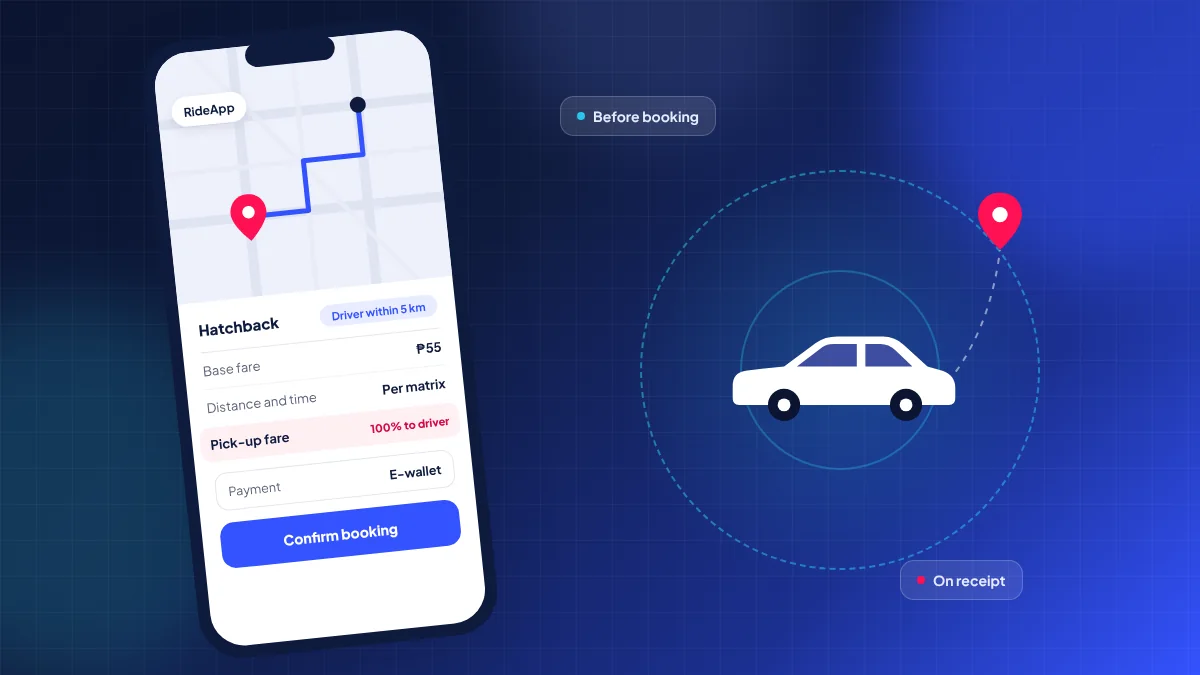
| How it scales | By the driver’s distance to the passenger, up to 5 km |
| Matching radius | 5 km maximum |
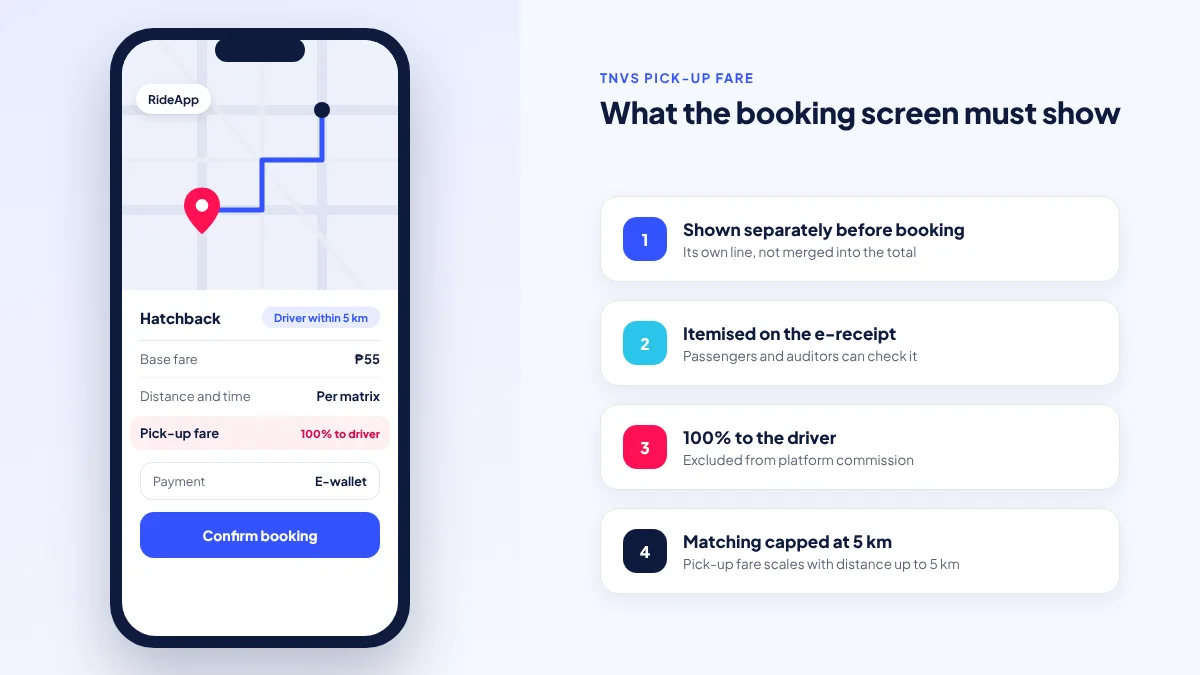
| Who keeps it | 100% to the driver; no commission |
| Display | Shown separately before booking and on the receipt |
What this changes inside the app
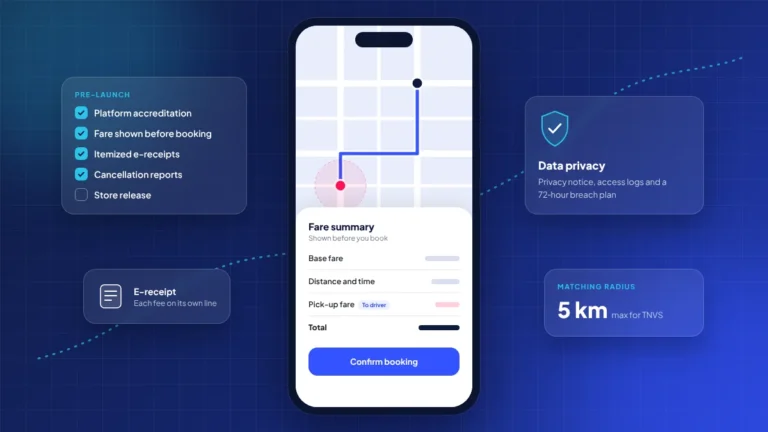
- Matching. The dispatch logic must not offer a request to a driver more than 5 km away. If no driver is within range, the app needs a clear “no drivers nearby” state rather than silently widening the search.
- Pricing. The pick-up fare is a distinct component calculated from the driver-to-pickup distance, using the band for the vehicle type.
- Display. The passenger must see the pick-up fare as its own line before confirming, and again on the e-receipt.
- Settlement. Commission calculations must exclude the pick-up fare entirely, and driver earnings screens should show it separately so drivers can verify it.
There is a subtle challenge here. At request time, the system does not yet know which driver will accept. ServicioPro’s approach is to show the pick-up fare once a driver is matched and before the trip is confirmed, or to show the band and lock the final amount at match. Which approach satisfies the “before booking” requirement is a question for the LTFRB, not for your developer.
Rule 3: New TNVS fares from September 28 (in force)
PUV fare increases approved in March 2026 were suspended on March 19, then took effect on September 28, 2026 after the DOTr lifted the suspension. New TNVS base fares also started on September 28. The Daily Tribune reported these TNVS base fares:
| Vehicle type | Previous base fare | From September 28, 2026 |
|---|---|---|
| Hatchback | ₱35 | ₱55 |
| Sedan | ₱45 | ₱65 |
| AUV | ₱55 | ₱75 |
| Premium | ₱145 | ₱165 |
Philstar described the adjustment as about 20%, so confirm the full official fare matrix, including per-kilometre and per-minute rates, before updating production.
The same Tribune report said the LTFRB summoned 19 TNCs for not implementing the new fares, with a hearing on October 7, 2026. That matter is pending; we found no reported outcome.
A fare that lives in code ships late. A fare that lives in configuration ships on the effective date.
Rule 4: Cancellations count as refusal to convey (in force)
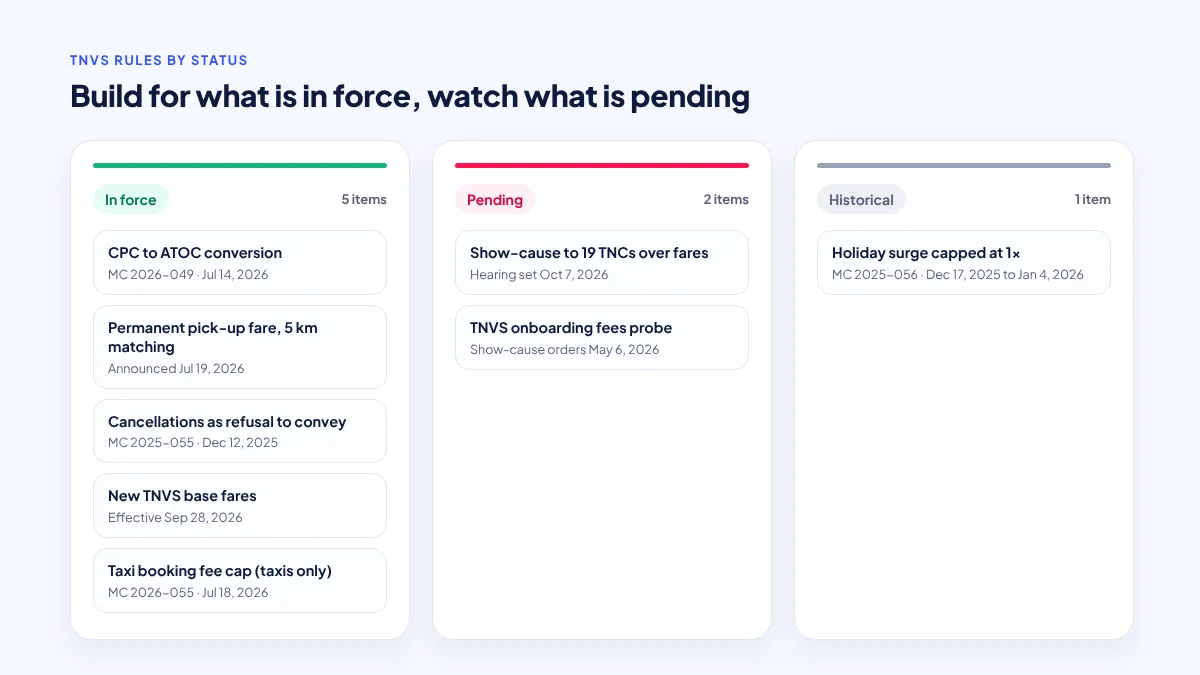
MC 2025-055, reported on December 12, 2025 by Top Gear Philippines, treats booking cancellations as refusal to convey under JAO 2014-01. Reported penalties escalate through ₱5,000, ₱10,000 and ₱15,000, up to cancellation of the CPC. TNCs must also report cancellations monthly.
Data you need to capture
- Who cancelled (passenger, driver or system) and when, relative to acceptance.
- The reason selected and any free-text explanation.
- Driver location and distance to pickup at the time of cancellation.
- Vehicle and franchise identifiers, so reports map to the right operator.
Without clean cancellation data, a TNC cannot produce a reliable monthly report, and an operator cannot contest a penalty. Driver apps should make the consequences visible: a confirmation step that explains a cancellation may be recorded is fair to drivers and reduces careless taps.
Rule 5: Taxi booking fees are capped, but not TNVS (in force for taxis)
MC 2026-055, reported by Philstar on July 18, 2026, caps booking fees for app-booked taxis at the lower of 20% of the fare or ₱60. The fee must be disclosed before booking and itemised on the receipt. It does not apply to TNVS.
If your platform serves both taxis and TNVS, the pricing engine needs separate rule sets per service type. A taxi trip gets a booking fee line subject to the cap; a TNVS trip gets a pick-up fare line that goes entirely to the driver.
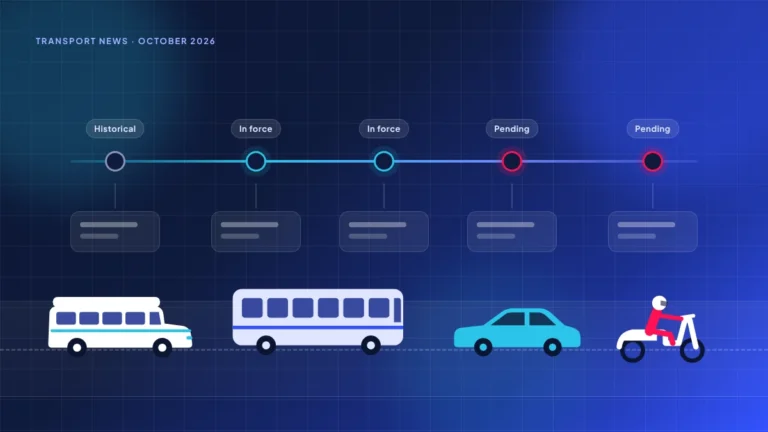
Current, pending and historical: one table
| Rule or action | Date reported | Status |
|---|---|---|
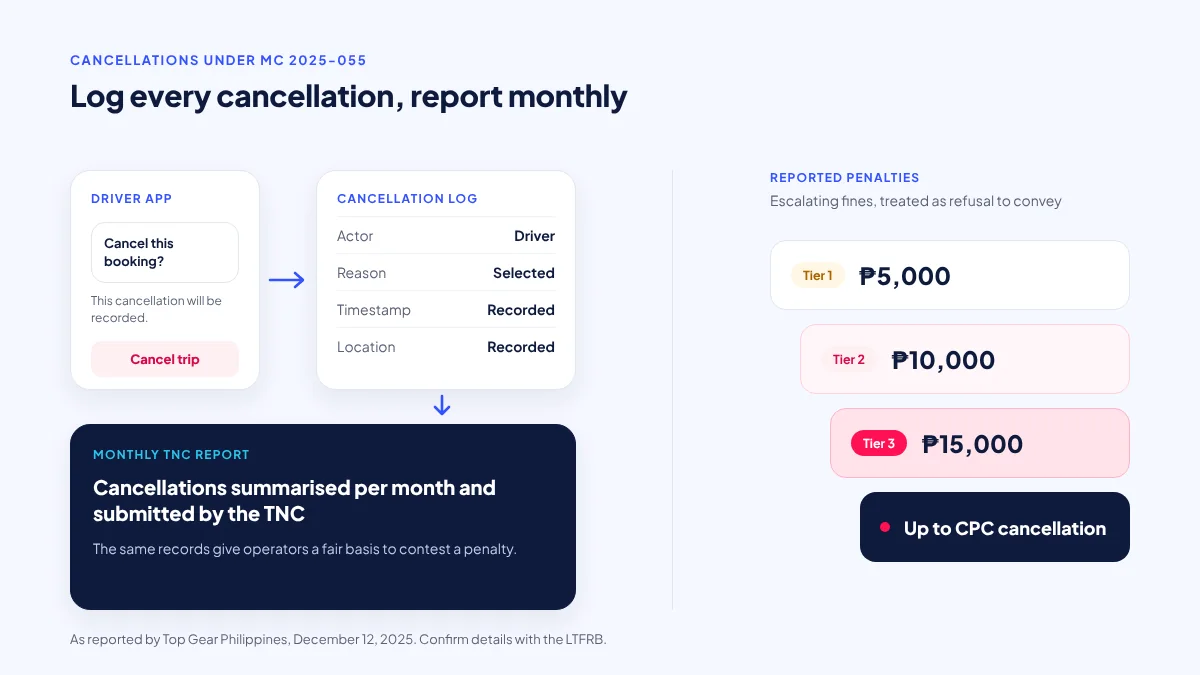
| CPC to ATOC conversion (MC 2026-049) | July 14, 2026 | In force |
| No hearing for compliant renewals (MC 2026-035, 2026-038) | May 21, 2026 | In force |
| Permanent fixed pick-up fare, 5 km matching | July 19, 2026 | Announced as permanent |
| Cancellations as refusal to convey (MC 2025-055) | December 12, 2025 | In force |
| New TNVS base fares | Effective September 28, 2026 | In force |
| Taxi booking fee cap (MC 2026-055) | July 18, 2026 | In force (taxis only) |
| Show-cause to 19 TNCs over fares | October 1, 2026 | Pending |
| TNVS onboarding “fees” probe | May 6, 2026 | Pending |
| Holiday surge cap at 1x (MC 2025-056) | Dec 17, 2025 to Jan 4, 2026 | Historical |
The holiday surge cap limited surge to 1x with no commission on surge during the 2025 holidays, according to the Inquirer. It has ended, but a similar seasonal cap could return, so a surge multiplier ceiling should be an admin setting.
Enforcement is real
On February 27, 2026, the LTFRB suspended three TNCs for 12 months for non-compliance, ignoring show-cause orders and having no active platform, as reported by the Daily Tribune. In May, DZRH reported show-cause orders over alleged onboarding “fees” of ₱25,000 to ₱90,000 and about 230,000 questionable entries. Both show that the board checks what platforms actually do, not just what they file.
For driver recruitment practices that hold up under that scrutiny, see our rider supply and onboarding playbook.
Developer compliance checklist
This is ServicioPro’s working checklist, based on the reported rules above. Validate it against official circulars.
- Fare tables per vehicle type, editable in admin, with an effective date and time.
- Pick-up fare bands per vehicle type, calculated from driver-to-pickup distance up to 5 km.
- Matching radius hard-capped at 5 km for TNVS.
- Pick-up fare shown as its own line before confirmation and on the e-receipt.
- Commission engine that excludes the pick-up fare.
- Separate pricing rules for taxis, with the booking fee cap enforced automatically.
- Surge ceiling setting that admins can lower to 1x for a date range.
- Cancellation logging with actor, reason, timestamp and location.
- Monthly cancellation report export.
- Franchise records storing ATOC status and validity.
- Privacy controls under the Data Privacy Act (RA 10173) for passenger and driver data.
For the architecture behind these features, read how ride-hailing apps work. For broader context on building such a platform, see what drives the cost of a Grab-like app and maps and location API costs.
Frequently asked questions
Do TNVS operators still need to renew their franchise?
Under MC 2026-049, valid TNVS CPCs were automatically converted to ATOCs with five-year validity and no renewal filing. Expired, revoked or suspended CPCs are excluded, so confirm your status with the LTFRB.
Can a ride-hailing platform take a commission on the pick-up fare?
No. Reports on the permanent pick-up fare policy say it goes 100% to the driver with no commission.
How far away can a matched TNVS driver be?
Up to 5 km, according to reports on the pick-up fare rules. The pick-up fare scales with distance up to that limit.
What happens if a TNVS driver keeps cancelling bookings?
Under MC 2025-055, cancellations can be treated as refusal to convey, with reported fines of ₱5,000, ₱10,000 and ₱15,000, up to CPC cancellation.
Does the ₱60 booking fee cap apply to TNVS rides?
No. MC 2026-055 covers app-booked taxis only, according to Philstar.
Is surge pricing still capped?
The 1x holiday cap under MC 2025-056 ran from December 17, 2025 to January 4, 2026 and has ended. Check with the LTFRB for any current or seasonal limits.
Sources
Researched October 26, 2026. Dates show when each source was published.
- LTFRB: TNVS CPCs to be automatically converted into ATOCs, Philippine Daily Inquirer, July 2026.
- LTFRB removes franchise renewal application requirement for TNVS, Philstar, July 16, 2026.
- LTFRB removes hearings, newspaper notices for PUV franchise renewals, AutoIndustriya, May 21, 2026.
- LTFRB brings back fixed pick-up fare policy for TNVS, GMA News, July 2026.
- LTFRB rules set fixed TNVS pick-up rates, Daily Tribune, July 19, 2026.
- LTFRB summons 19 ride-hailing firms over unimplemented fare hike, Daily Tribune, October 1, 2026.
- DOTr lifts suspension of PUV fare hike, Philstar, September 26, 2026.
- LTFRB memo on TNVS booking cancellations, Top Gear Philippines, December 12, 2025.
- LTFRB caps app-booked taxi fees at P60, Philstar, July 18, 2026.
- LTFRB issues circular imposing changes in surge pricing for TNVS, Philippine Daily Inquirer, December 2025.
- LTFRB TNVS surge pricing reduction, GMA News, December 2025.
- LTFRB suspends 3 ride-hailing firms over franchise violations, Daily Tribune, February 27, 2026.
- LTFRB serves show-cause orders on ride-hailing firms amid widening TNVS probe, DZRH, May 6, 2026.