9 min read
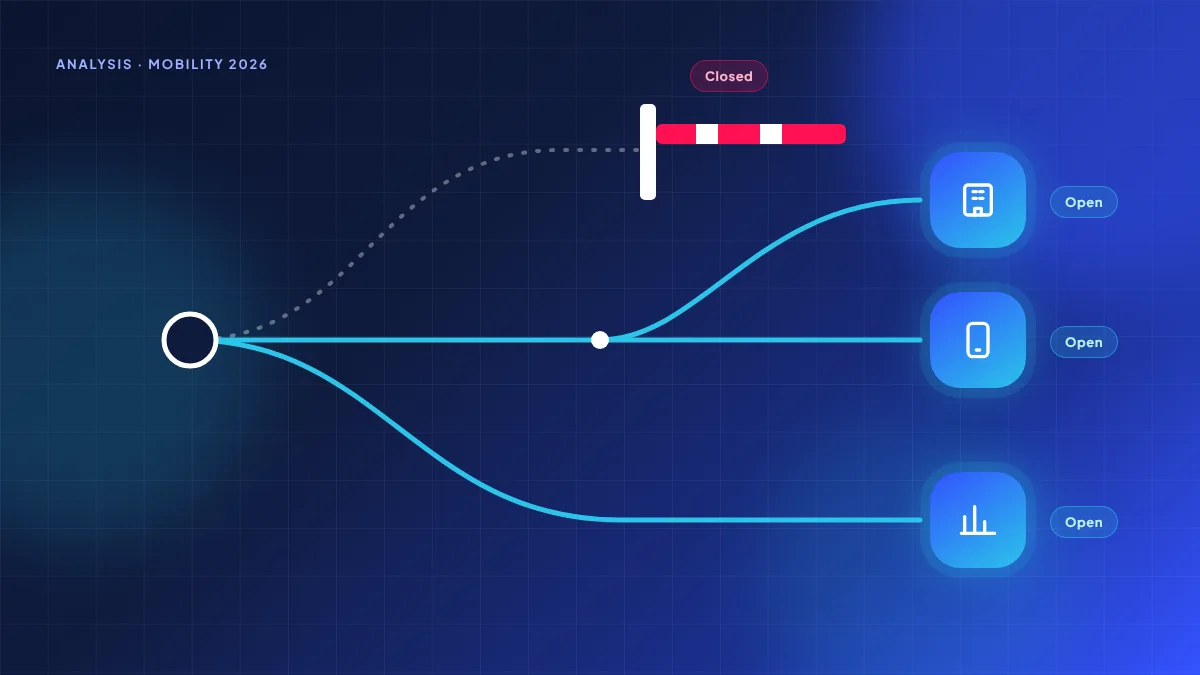
In ServicioPro’s analysis, the 2026 LTFRB policies make the Philippine mobility market harder to enter as a new consumer platform and more attractive for companies that build for those already licensed. Motorcycle taxi accreditation was opened with “no new players”, enforcement against TNCs is frequent, and fare rules now dictate how some charges are displayed and who keeps them. That shifts the realistic opportunities toward B2B software, compliance tooling and services for accredited operators.
This article is clearly labelled analysis. The policies it discusses are drawn from Philippine news reports of LTFRB and DOTr actions, researched on October 26, 2026, each cited with its date. The interpretations are ours, not official positions, and nothing here is legal advice. For the underlying news, see our LTFRB updates for October 2026.
The facts this analysis rests on
| Policy or action | Date reported | Status |
|---|---|---|
| Motorcycle taxi pilot framework kept until a law passes (DOTr DO 2026-006) | March 2026 | In force |
| Motorcycle taxi operating rules (MC 2026-048) | July 7, 2026 | In force (pilot framework) |
| Motorcycle taxi platform accreditation, “no new players” | Opened August 5, 2026 | Announced |
| GrabBike and Dingdong RiderKo bids rejected | October 12, 2026 | Reported decision |
| Motorcycle taxi law | April 16, 2026 | Pending in Congress |
| Three TNCs suspended for 12 months | February 27, 2026 | In force when reported |
| Show-cause orders on TNVS onboarding “fees” | May 6, 2026 | Pending |
| Show-cause orders to 19 TNCs over fares | October 1, 2026 | Pending |
| Permanent TNVS pick-up fare, 5 km matching | July 19, 2026 | Announced as permanent |
| Taxi booking fee cap (MC 2026-055) | July 18, 2026 | In force |
| Cancellations as refusal to convey (MC 2025-055) | December 12, 2025 | In force |
| TNVS CPCs converted to ATOCs (MC 2026-049) | July 14, 2026 | In force |
Barrier 1: Motorcycle taxis are closed to new platforms
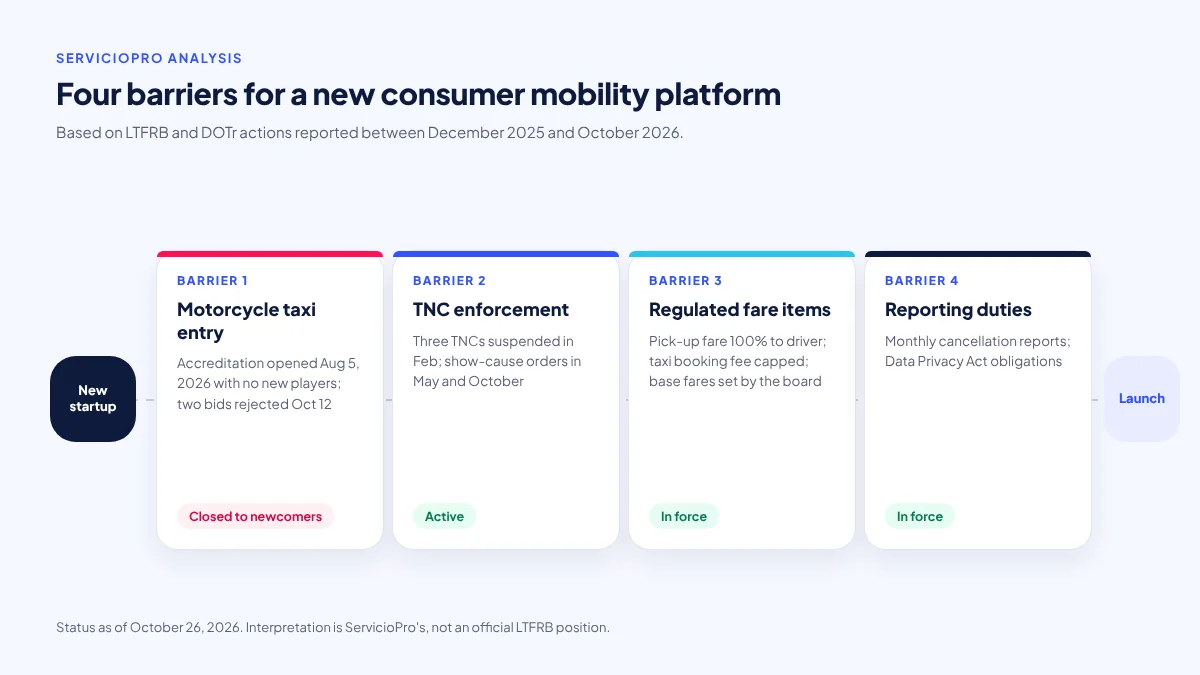
Motorcycle taxis remain under a pilot framework. DOTr DO 2026-006 keeps that framework until Congress passes a law, and the House called such a law a priority in April 2026, according to Newsbytes. When platform accreditation opened on August 5, 2026, GMA News reported there would be “no new players”. On October 12, GMA News reported the LTFRB rejected GrabBike’s and Dingdong RiderKo’s bids for failing to prove continued pilot operation.
Our analysis: if even large, well-known brands were turned away for not proving continued pilot operation, a new startup has no realistic path into motorcycle taxis under the current framework. The opening, if one comes, depends on the pending law. Founders who want this segment should track the bill, not build an app speculatively.
Barrier 2: Enforcement raises the cost of being a TNC
2026 brought steady enforcement. In February, the LTFRB suspended Leggo IT Solutions, Get Express Global and Ipara Technology Solutions for 12 months over non-compliance, ignored show-cause orders and no active platform, the Daily Tribune reported. In May, DZRH reported show-cause orders over alleged onboarding “fees” of ₱25,000 to ₱90,000 and about 230,000 questionable entries. In October, 19 TNCs were summoned for not applying the September 28 fare increase, according to the Daily Tribune.
Our analysis: three patterns stand out.
- Dormancy is punished. Holding accreditation without an active platform is itself a risk. Startups should not seek accreditation as a placeholder.
- Driver onboarding is scrutinised. Recruitment practices and data quality matter, not just the number of drivers signed up.
- Speed of compliance matters. A platform that cannot apply a fare change on the effective date can face a show-cause order.
For a startup, this means compliance is a team and a system from day one: someone who reads circulars, an admin panel that can apply them, and records that prove what was done.
In 2026, a ride platform’s ability to change its rules quickly is as important as its ability to find drivers.
Barrier 3: Fare rules shape unit economics
Several rules now fix what certain charges are and who keeps them:
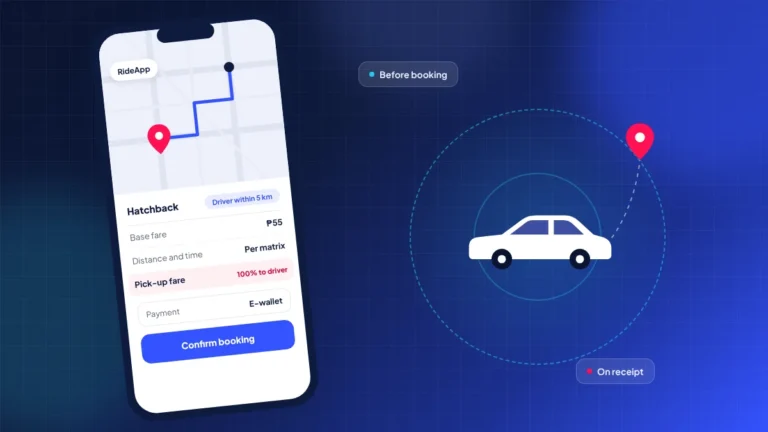
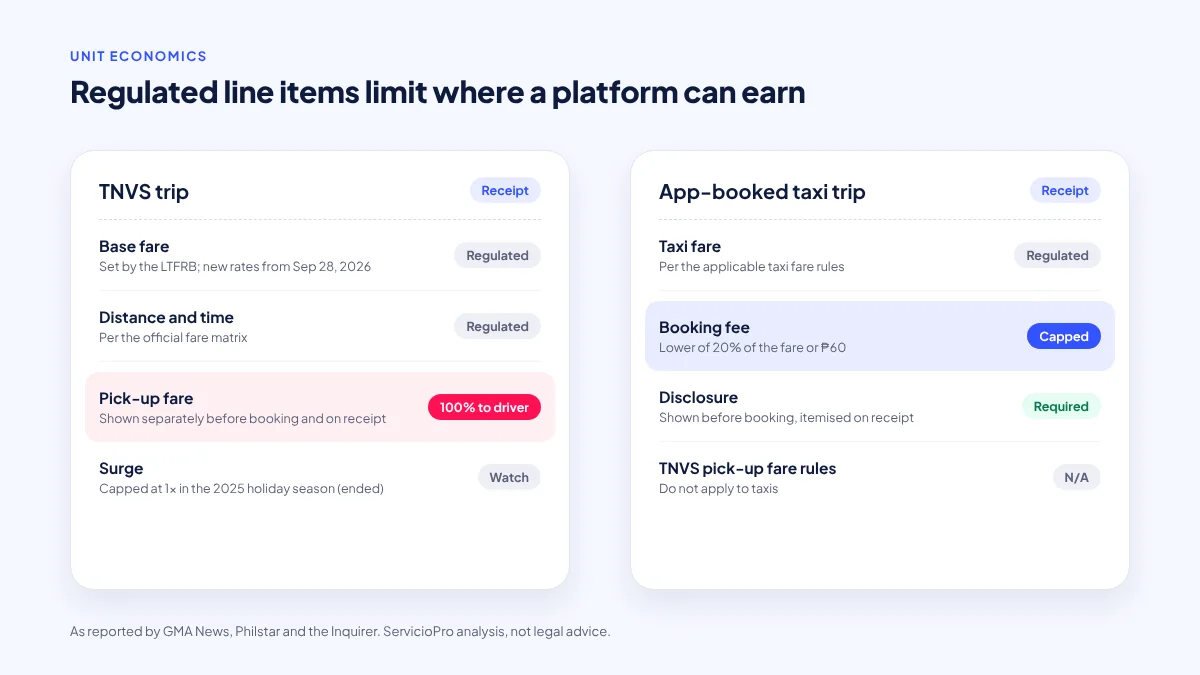
- The TNVS pick-up fare, ₱24 to ₱120 for hatchbacks up to ₱58 to ₱289 for premium, goes 100% to the driver with no commission and must be shown separately before booking and on the receipt, according to GMA News.
- App-booked taxi booking fees are capped at the lower of 20% of the fare or ₱60 under MC 2026-055, Philstar reported.
- The December 2025 holiday surge cap (MC 2025-056) limited surge to 1x with no commission on surge. It has ended, but it shows the regulator will act on peak pricing.
- Base fares are set by the board; new TNVS base fares took effect September 28, 2026.
Our analysis: a startup cannot assume it can monetise every peso a passenger pays. Financial models should separate regulated line items (base fare, pick-up fare, booking fee) from the platform’s take and stress-test scenarios where surge is capped during peak periods. Models that rely heavily on surge or fees layered on top of the fare are the most exposed.
Barrier 4: Operations and reporting duties
Under MC 2025-055, booking cancellations can be treated as refusal to convey, with reported fines of ₱5,000, ₱10,000 and ₱15,000 up to CPC cancellation, and TNCs must report cancellations monthly, as reported by Top Gear Philippines. Add the Data Privacy Act (RA 10173) and the operational load is significant for a small team.
On the positive side, MC 2026-049 converted valid TNVS CPCs into ATOCs with five-year validity and no renewal filing, which reduces paperwork for operators already in the system. Our analysis: that favours incumbents and their partners, because the benefit flows to existing franchise holders.
Where the opportunities are
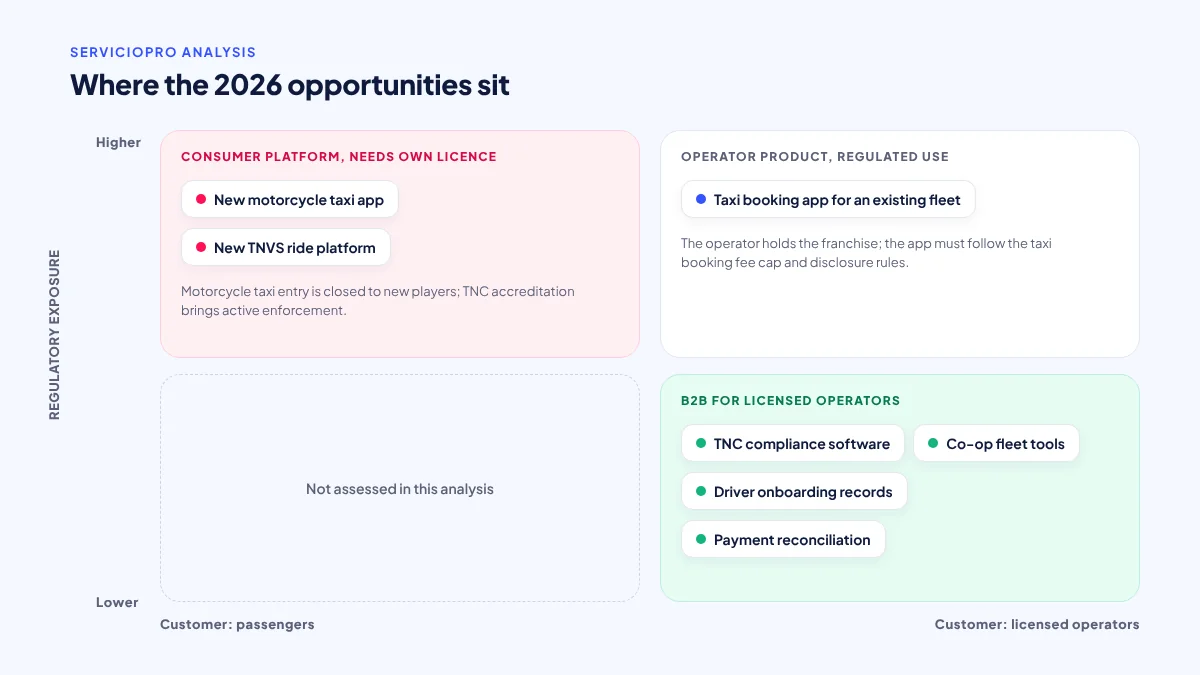
If the consumer front door is narrow, the side doors are wider. In our analysis, these are the most promising directions for 2026.
1. Software for accredited TNCs
Accredited platforms need to apply fare changes on time, compute pick-up fares within the 5 km radius, exclude non-commissionable items from settlement, and file cancellation reports. Configurable pricing engines, reporting modules and audit trails are concrete products.
2. Booking apps for taxi operators
MC 2026-055 sets clear rules for app-booked taxis: a capped booking fee, disclosed before booking and itemised on the receipt. Taxi fleets that already hold franchises can add app booking within those rules. A taxi booking app for an existing operator avoids the hardest entry barrier entirely.
3. Fleet and dispatch tools for PUV cooperatives
Consolidated cooperatives manage shared fleets, maintenance and remittances. Our PUV modernization and fleet management guide covers what they need.
4. Compliance and driver-onboarding services
Given the onboarding probe, clean and verifiable driver records are valuable. Tools that document recruitment, verify documents and track expiry dates serve both TNCs and operators.
5. Payments and reconciliation
Digital payments reached 64.7% of retail payment volume in 2025, according to BSP data reported by the Daily Tribune. Products that help operators reconcile cash and digital collections against trips have a growing market.
Product implications if you are building anyway
For founders who do hold, or are working toward, the right accreditation, our recommended product principles are:
- Make every fare rule configurable with effective dates, so circulars become settings changes.
- Itemise everything before booking and on receipts, including pick-up fares and booking fees.
- Separate earnings logic so non-commissionable items stay whole for drivers.
- Log cancellations with actor, reason, time and location.
- Cap surge in settings, not in code, so a seasonal limit can be applied in minutes.
- Keep driver onboarding auditable, with no fees that could be questioned.
- Design for privacy under RA 10173 from the start.
Our ride-booking app compliance checklist turns these into a pre-launch list, and white-label versus custom build helps you choose how to build.
Questions to answer before you raise or spend
Before committing budget to a mobility product, we suggest founders write down clear answers to these questions. If any answer is “we are not sure”, that is the first thing to resolve.
- Which LTFRB accreditation, franchise or authority does our model need, and can we obtain it today?
- Who is our paying customer: passengers, drivers, operators or accredited platforms?
- Which parts of the fare are regulated, and what is left for our revenue?
- How fast can we apply a new circular across apps, receipts and reports?
- Who on the team owns compliance, and how will we prove what we did?
- How do we handle passenger and driver data under the Data Privacy Act?
Startups that sell to operators can usually answer the first three questions more easily, which is another reason we see the B2B path as the lower-risk one in 2026.
What could change the picture
- A motorcycle taxi law could create a formal entry process. It is pending in Congress.
- Outcomes of pending show-cause hearings will show how strictly the board penalises fare and onboarding issues.
- Further fare or surge circulars would change unit economics again.
Frequently asked questions
Can a new startup launch a motorcycle taxi app in 2026?
Not as a platform provider under the current framework, in our reading. Accreditation opened on August 5, 2026 with “no new players”, according to GMA News. A pending law may change this.
Is a TNVS or taxi startup still possible?
Possibly, but only through proper LTFRB accreditation and franchises, with compliance built in from the start. Check requirements with the LTFRB or a lawyer.
Can a platform earn from the TNVS pick-up fare?
No. Reports say it goes 100% to the driver with no commission.
What is the lowest-risk way into mobility tech right now?
In ServicioPro’s analysis, building software or services for operators who already hold franchises or accreditation, such as TNCs, taxi fleets and PUV cooperatives.
Is this analysis an official LTFRB position?
No. It is ServicioPro’s interpretation of reported policies. Confirm anything that affects your business with the LTFRB or a lawyer.
Sources
Researched October 26, 2026. Dates show when each source was published.
- LTFRB MC taxi rules: allowed bikes, 60 km/h limit, passenger refusal and more, Motopinas, July 7, 2026.
- LTFRB sets Aug. 5 opening of motorcycle taxi platform provider accreditation, GMA News, July 30, 2026.
- LTFRB rejects GrabBike, Dingdong RiderKo accreditation bids, GMA News, October 12, 2026.
- House vows to pass motorcycle taxi law to formalize digital ride-hailing, Newsbytes.PH, April 16, 2026.
- LTFRB suspends 3 ride-hailing firms over franchise violations, Daily Tribune, February 27, 2026.
- LTFRB serves show-cause orders on ride-hailing firms amid widening TNVS probe, DZRH, May 6, 2026.
- LTFRB summons 19 ride-hailing firms over unimplemented fare hike, Daily Tribune, October 1, 2026.
- LTFRB brings back fixed pick-up fare policy for TNVS, GMA News, July 2026.
- LTFRB caps app-booked taxi fees at P60, Philstar, July 18, 2026.
- LTFRB issues circular imposing changes in surge pricing for TNVS, Philippine Daily Inquirer, December 2025.
- LTFRB memo on TNVS booking cancellations, Top Gear Philippines, December 12, 2025.
- LTFRB: TNVS CPCs to be automatically converted into ATOCs, Philippine Daily Inquirer, July 2026.
- BSP: Digital payments account for nearly two-thirds of retail volume, Daily Tribune, August 19, 2026.