11 min read
A digital dispatch system replaces the clipboard, the radio and the group chat with one shared record of which vehicle goes where, when, and with which driver. For taxi fleets it means assigning booked trips; for buses, jeepneys and UV Express it means managing terminal queues, headways and trip logs on fixed routes. The best systems are built for each mode’s real workflow and keep working when mobile signal drops.
Philippine transport operators are being asked for more records than ever: posted fare matrices after the September 28, 2026 fare changes, roadworthiness checks under the consolidation program, cancellation data for app-based services, and official email for franchise renewals. Dispatch software is where those records come from. This guide explains what a dispatch system does for each mode, which features matter, how to design for weak connectivity, and how to roll it out without disrupting daily trips.
What a digital dispatch system actually does
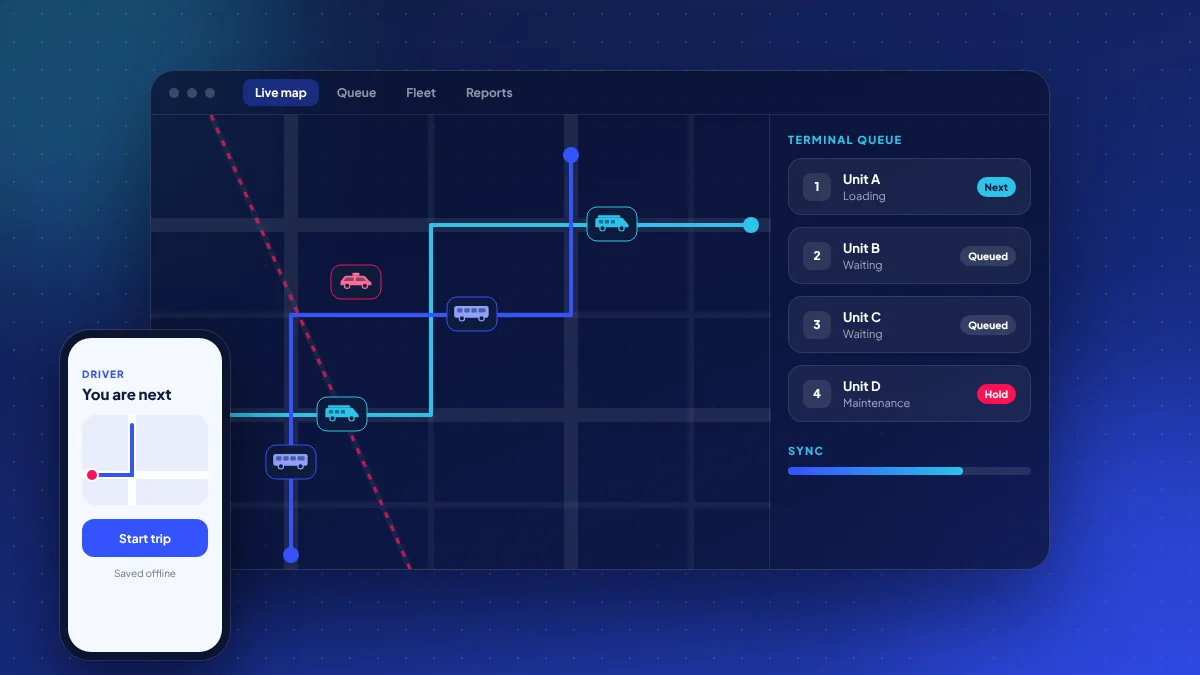
Strip away the branding and every dispatch system has the same job: turn vehicles, drivers and demand into a plan, then record what actually happened. Most systems combine five modules:
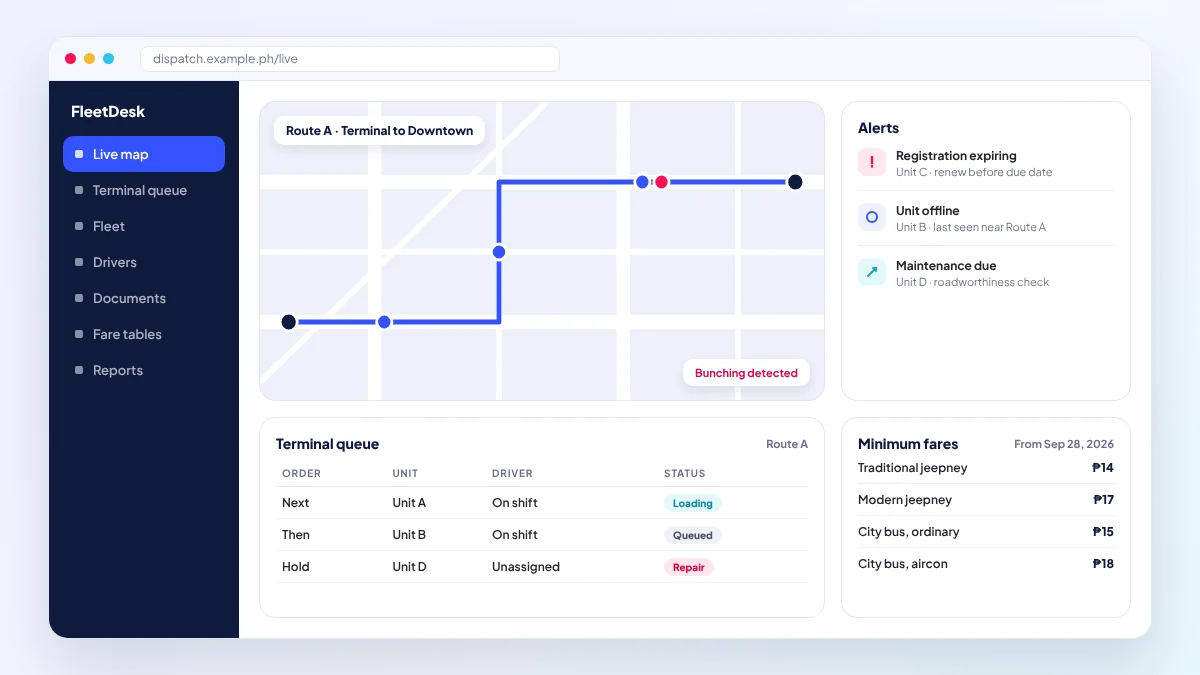
- Fleet and driver registry. Every unit with its plate, franchise or authority details, insurance, roadworthiness dates and assigned drivers.
- Assignment or queueing. Either matching a booking to a vehicle (taxi) or deciding which unit leaves the terminal next (bus, jeepney, UV Express).
- Live tracking. GPS positions from a driver phone or a vehicle tracker, shown on a dispatcher map.
- Trip and fare records. Departures, arrivals, passenger counts or fares collected, and incidents.
- Reports and alerts. Daily summaries, overdue maintenance, expiring documents, and units that went off-route or offline.
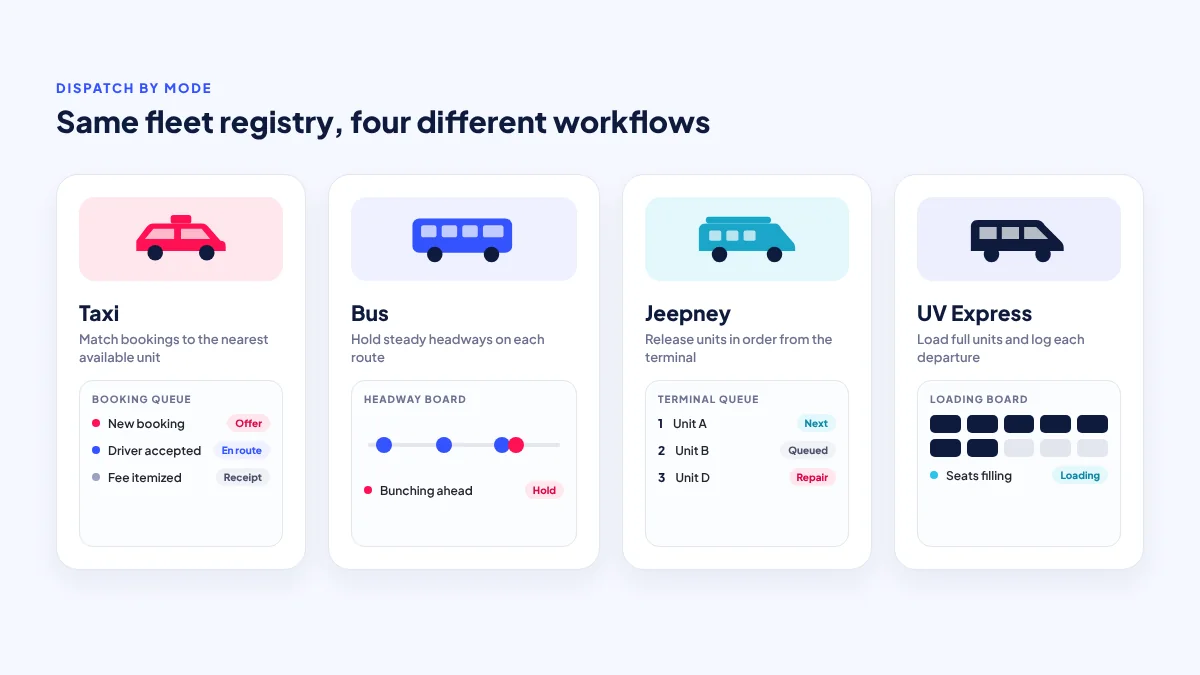
How much of each module you need depends on the mode. A taxi fleet lives in the assignment module. A jeepney cooperative lives in queueing, trip logs and maintenance.
Dispatch by mode
Taxi fleets
Taxi dispatch is closest to ride-hailing. Bookings arrive by app, phone or partner desk; the system finds the nearest available unit and offers the trip. If your fleet takes app bookings, note that Philstar reported on July 18, 2026 that the LTFRB’s MC 2026-055 caps the app-booked taxi booking fee at the lower of 20% of the fare or ₱60, which must be disclosed before booking and itemized on the receipt. The dispatch system therefore needs a fee calculator and receipt template, not just a map. Our guide to a taxi booking app like Grab covers the passenger side.
City and provincial buses
Bus dispatch is about headways: keeping a steady gap between buses on the same route so they do not bunch up. The dispatcher sets a timetable or target interval, the system tracks each bus, and the terminal releases the next unit on schedule. Useful extras are conductor apps for ticket counts, and route-level reports that show which hours run full and which run empty. With fare changes effective September 28, 2026, Philstar and GMA News reported a ₱15 minimum for ordinary city buses, ₱18 for air-conditioned city buses and ₱12 for ordinary provincial buses, with point-to-point buses up 15%. Any conductor app must load those values from the server.
Jeepneys and modern PUVs
Jeepney dispatch usually happens at a terminal or route endpoint. Units queue, the dispatcher releases them in order, and the cooperative tracks rounds per unit per day. For consolidated cooperatives, the bigger value is fleet-level visibility: which units are on the road, which are in maintenance, and how revenue compares across units. According to reports on the September 28 fare changes, the minimum fare is ₱14 for traditional jeepneys and ₱17 for modern jeepneys. For the policy background, see our sibling article on PUV modernization and digital fleet management.
UV Express
UV Express services typically run point-to-point between terminals and leave when the vehicle is full or a scheduled time arrives. Dispatch here is a queue plus a passenger manifest: which unit is loading, how many seats are filled, and when it departed. A simple tablet app at the terminal often delivers most of the value, with driver phones adding live location for the receiving terminal.
| Mode | Main dispatch job | Key screens | Typical data captured |
|---|---|---|---|
| Taxi | Match bookings to nearby units | Booking queue, live map, driver offer screen | Booking time, assignment, fare, booking fee, cancellations |
| Bus | Hold headways on a route | Timetable board, route map, conductor app | Departures, arrivals, ticket counts, delays |
| Jeepney / modern PUV | Release units from terminal queue | Terminal queue, unit status, maintenance list | Rounds per unit, fares collected, downtime |
| UV Express | Load and release full units | Loading board, seat count, manifest | Departure time, seats filled, arrival |
Features that matter, and why
Feature lists from software vendors are long. These are the ones that earn their keep in Philippine operations:
| Feature | Why it matters |
|---|---|
| Admin-editable fare tables with effective dates | Fares changed on September 28, 2026 after a suspension earlier in the year. Changing fares should never need a new app release. |
| Document expiry alerts | Franchise, authority, insurance and registration dates in one place, with reminders before they lapse. |
| Maintenance logs and roadworthiness checklists | DOTr’s 2025 consolidation order ties provisional authority to LTO roadworthiness, and the LTFRB has floated denying renewal to dilapidated units. |
| Driver assignment and shift records | Shows who drove which unit when, which matters for incidents, payroll inputs and conduct rules. |
| Offline trip capture | Routes cross dead zones; trips must still be recorded. |
| Role-based access | Dispatchers, cooperative officers and auditors see only what they need. |
| Exportable reports | Cooperatives, lenders and regulators ask for numbers in spreadsheets, not screenshots. |
On roadworthiness: DOTr Department Order 2025-009, as reported by Inquirer on May 7, 2025, reopened consolidation only on routes that were at least 60% consolidated and paired a one-year provisional authority with LTO roadworthiness checks. Separately, ABS-CBN reported on January 23, 2026 that the LTFRB was considering denying franchise renewal to dilapidated PUVs. That proposal is not in force, but a maintenance log will matter either way.
Driver conduct and communication
Dispatch apps put a phone in front of the driver, so design for safety. Show offers and queue updates as large, glanceable cards, and lock non-essential screens while the vehicle is moving. AutoIndustriya reported in July 2026 that the LTFRB was finalizing a rule against vlogging or livestreaming while driving a PUV, with a ₱5,000 fine; that rule was still pending, but a dispatch app should never encourage screen use while driving.
Official email and renewals
According to AutoIndustriya (May 21, 2026), LTFRB circulars MC 2026-035 and MC 2026-038 removed newspaper notices of hearing and hearings for compliant franchise renewals, and require operators to keep a valid email address as the official channel. Make that address a shared inbox, not one officer’s personal account, and link renewal dates from your registry to reminders.
Designing for offline realities
DataReportal’s Digital 2026 report counts 98.0 million internet users in the Philippines, or 83.8% of the population. That is high, but it also means many routes pass through places and moments with no usable signal: provincial highways, mountain roads, underpasses and crowded terminals at rush hour. A dispatch system that freezes without data will be abandoned within a week.
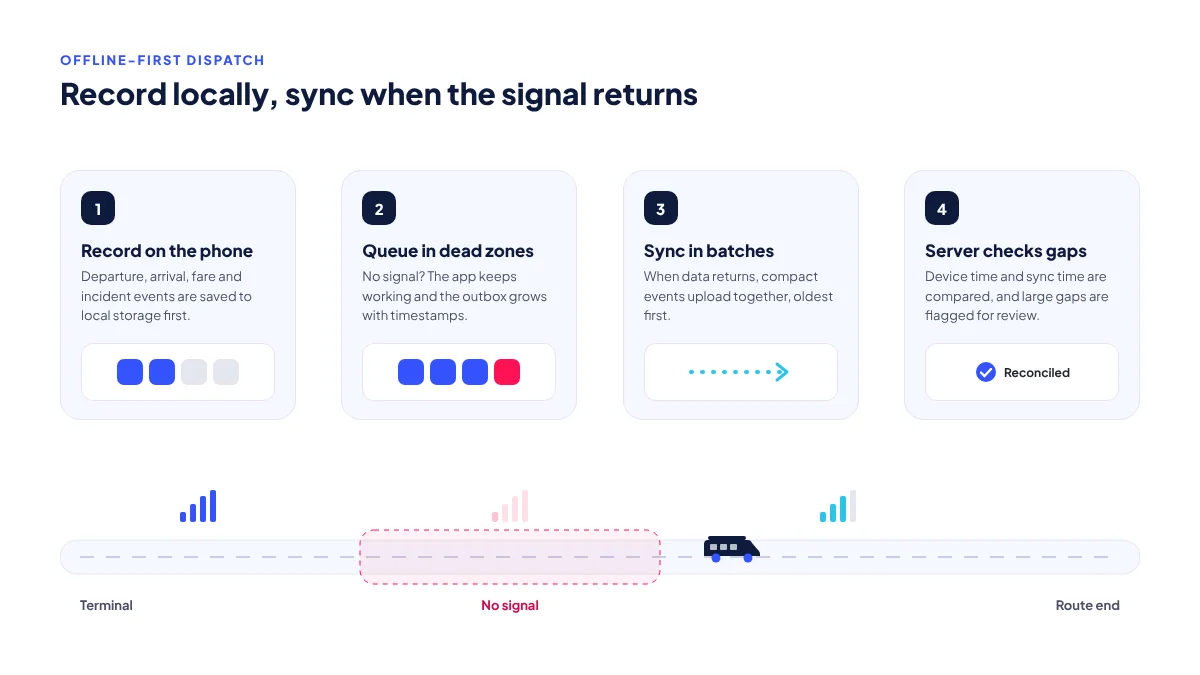
Offline-first design means:
- Local storage first. The driver or conductor app writes every event (departure, arrival, fare, incident) to the phone, then syncs when connected.
- Timestamps from the device, checked by the server. Record the device time and the sync time, and flag large gaps.
- Conflict rules. Decide in advance what happens if the terminal tablet and the driver app disagree about a departure.
- Light payloads. Send compact location points, not map tiles, and batch them.
- SMS or call fallback for the dispatcher. When the app cannot reach a driver, the dashboard shows the last known position and a one-tap call.
Our article on offline-first resilience for Philippine mobile apps covers the sync patterns in detail, and maps and location API costs explains how tracking frequency affects your bill.
Fare collection: what the past tells us
Cashless fare collection is attractive, but plan it carefully. In 2022, DOTr and Landbank piloted EMV card payments on 150 modern PUVs, as reported by AutoIndustriya. That pilot is historical; it shows the idea has been tested, not that a national system exists. For most operators, the practical first step is to record fares collected per trip in the conductor app and reconcile daily, then add QR or card payments where passengers already use them.
Rollout steps that avoid disrupting daily trips
- Map the current process. Sit at the terminal for a full day. Note how units are released, how fares are counted and where disputes happen.
- Clean the registry. Load every unit, driver, document and expiry date. This step alone often surfaces lapsed papers.
- Pick one route or terminal. Choose one with a cooperative dispatcher and a manageable number of units.
- Run paper and digital in parallel. Keep the logbook for two to four weeks and compare daily totals.
- Train with real devices. Use the phones drivers actually own, on the networks they actually use.
- Agree on reports. Decide with officers which daily and monthly reports replace manual summaries.
- Expand route by route. Add the next route only when the first runs without paper.
The best dispatch system is the one your dispatchers trust enough to put the logbook away.
Build, white-label or subscribe?
There are three ways to get dispatch software, and each fits a different operator:
- Subscription software suits small fleets that can live with a generic workflow and do not need their own branded passenger app.
- White-label apps give you branded passenger, driver and admin apps on a proven base, configured to your fares and service areas. ServicioPro’s white-label apps are priced from ₱100,000 to ₱800,000 depending on scope; see white-label vs custom build.
- Custom builds make sense when your workflow is unusual, such as a cooperative with several modes, or when dispatch must integrate with accounting, payroll inputs or a cooperative’s member system.
Cost drivers are similar in all three: number of apps (driver, conductor, terminal, passenger, admin), offline sync complexity, map and SMS usage, and reporting depth. We cannot give a market price for dispatch systems because no credible public benchmark exists; ask any vendor for a breakdown by module. See also Firebase vs a custom backend for the server choice.
What dispatch software does not do
Software can make compliance easier to prove, but it does not grant authority. A dispatch system does not give you a franchise, an authority to operate, route approval, or a pass on roadworthiness inspections. If you add app booking for the public, platform rules apply too; our ride-booking app compliance checklist covers those. When in doubt, confirm with the LTFRB or a transport lawyer.
Frequently asked questions
Do jeepney drivers need smartphones for a dispatch system?
Not always. A terminal tablet can run the queue and record departures by plate. Driver phones add live tracking and offline trip logs, so many cooperatives start with the tablet and add driver apps later.
Is GPS tracking required for PUVs?
We found no 2025–2026 news reports of a new GPS mandate for PUVs. Many operators still use tracking for headway control, incident evidence and fewer calls to drivers. Check current LTFRB requirements for your franchise.
How should the system handle fare changes?
Store fares as data with effective dates. When new minimum fares took effect on September 28, 2026, a system built this way only needed an admin update and a printed fare matrix.
Can one system handle buses, jeepneys and UV Express together?
Yes, if it treats each mode as a separate workflow on a shared fleet registry. The queue logic, fare rules and reports differ, but drivers, units and documents can live in one database.
What if the internet is down at the terminal?
An offline-first terminal app keeps the queue locally and syncs later. Pair it with a phone fallback for the dispatcher and a daily reconciliation report.
Sources
Researched October 26, 2026. Dates show when each source was published.
- DOTr lifts suspension of PUV fare hike, Philstar, September 26, 2026.
- DOTr approves LTFRB fare hike recommendation for PUVs, GMA News, September 2026.
- LTFRB caps app-booked taxi fees at P60, Philstar, July 18, 2026.
- DOTr reopens consolidation application for PUV operators, Inquirer.net, May 7, 2025.
- LTFRB eyes blocking franchise renewal of dilapidated PUVs, ABS-CBN News, January 23, 2026.
- LTFRB removes hearings, newspaper notices for PUV franchise renewals, AutoIndustriya, May 21, 2026.
- LTFRB bans PUV drivers from vlogging while driving, AutoIndustriya, July 6, 2026.
- DOTr starts pilot testing of EMV cards to pay PUV fares, AutoIndustriya, 2022.
- Digital 2026: The Philippines, DataReportal, November 5, 2025.