10 min read
The passenger safety features that matter most in a Philippine ride-hailing app are verified drivers tied to verified vehicles, live GPS trip sharing with an emergency button, clear fares shown before booking, and cashless payments. Each must be designed within the Data Privacy Act. The National Privacy Commission has already stopped one in-car recording feature, so “more data” is not automatically “more safety”.
Passengers judge a ride app on one question: will I get home safely and be charged what I expected? This article looks at the safety stack of a ride-hailing app from a product point of view: what to build before the trip, during the trip and after it, what the 2025–2026 regulatory reports imply, and where privacy law draws the line. It complements our broader post on trust and safety for on-demand apps, which covers fraud and platform abuse; here we focus on the passenger in the back seat.
Before the trip: verifying the driver and the vehicle
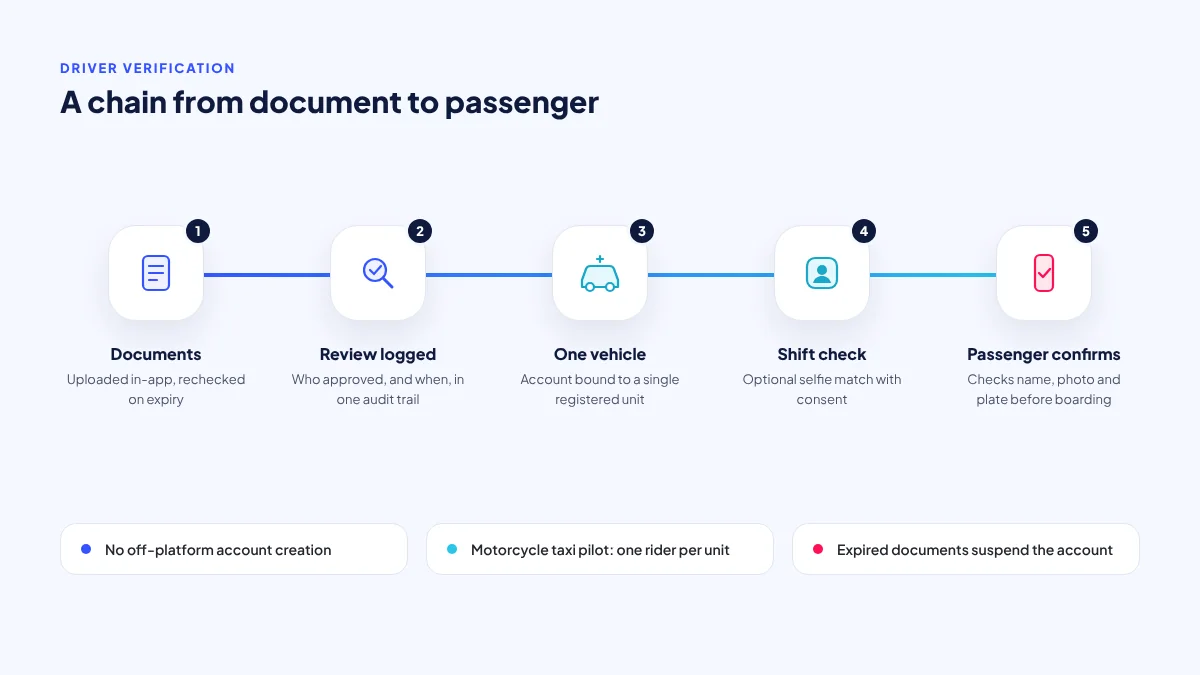
Most passenger safety failures start at onboarding. If the wrong person can drive under someone else’s account, every later feature is weakened. Verification has three parts.
Identity and documents
Collect the documents your accreditation and insurance require, and record who reviewed them and when. Keep copies only as long as needed and restrict who can view them in the admin panel. Re-check documents on expiry dates rather than once at sign-up.
One account, one person, one vehicle
The passenger sees a name, a photo, a plate number and a vehicle description. The system must make sure all four belong together. For motorcycle taxis under the current pilot framework, Motopinas reported on July 7, 2026 that LTFRB MC 2026-048 requires one rider per unit with no relievers, helmets, a 60 km/h limit with a passenger and app-only bookings with no street hail. In software terms, that means binding each rider account to one registered motorcycle and refusing trips if the bike on the trip does not match.
Practical controls that help:
- A selfie check against the onboarding photo at the start of a shift, with clear consent and a short retention period for the driver’s image.
- Plate and vehicle details shown large on the passenger’s screen, with a “this is not my driver” button.
- Automatic suspension of accounts whose documents have expired.
An onboarding audit trail
Verification also has to be provable. On May 6, 2026, DZRH reported that the LTFRB issued show-cause orders to ride-hailing firms over alleged onboarding “fees” of ₱25,000 to ₱90,000 and around 230,000 questionable entries. Those allegations were still being heard and are not findings. Still, the episode shows why every driver account should trace back to a documented review inside your own system, with no side doors for agents or brokers.
During the trip: tracking, sharing and calling for help
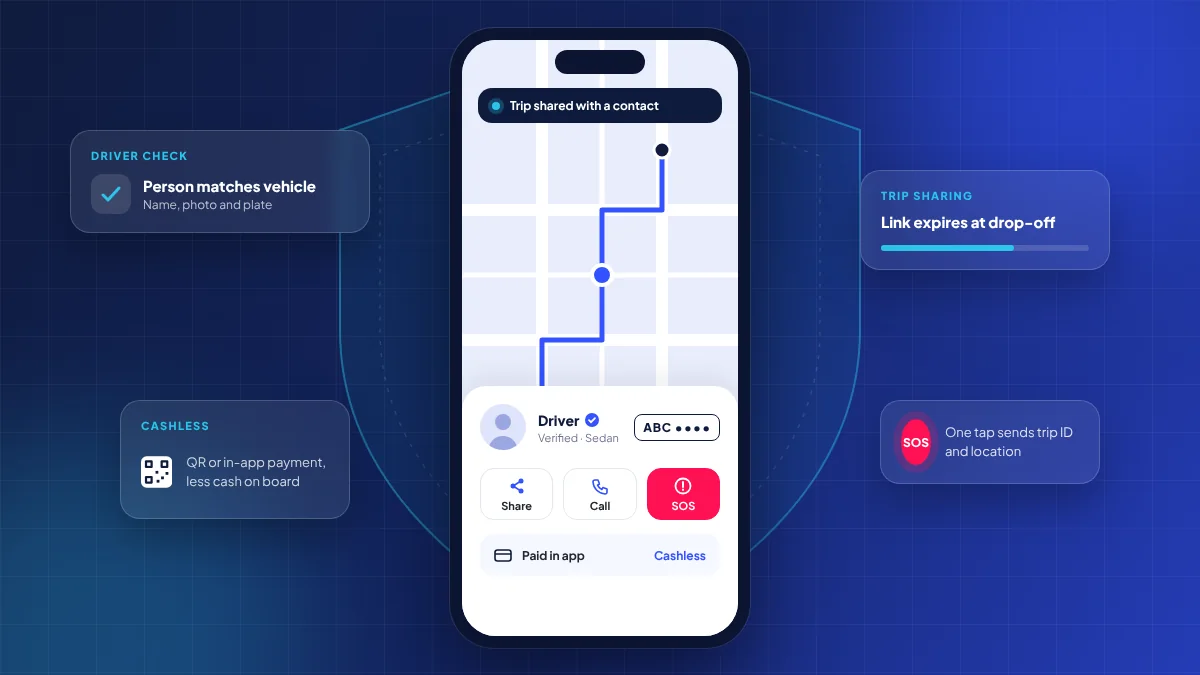
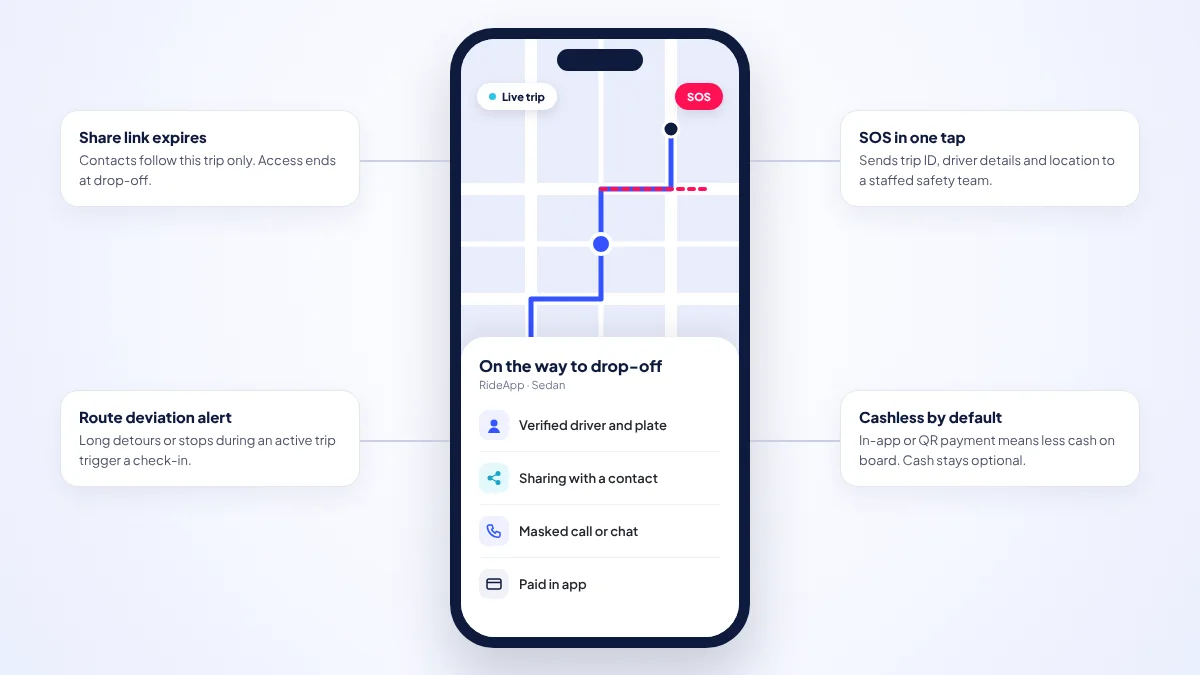
Once the passenger is in the car, safety features should be visible and one tap away, but not intrusive. These are the features we consider essential for a Philippine ride-hailing app:
| Feature | What it protects | Privacy-aware design |
|---|---|---|
| Live trip sharing | A trusted contact can follow the trip in real time | Link shows only the current trip and expires at drop-off |
| SOS / emergency button | Fast escalation to the platform’s safety team or a contact | Sends location and trip ID only when pressed |
| Route deviation alert | Flags long unexplained detours or stops | Uses trip GPS only while the trip is active |
| Masked calling and chat | Passenger and driver can talk without sharing phone numbers | Proxy numbers expire after the trip |
| Driver and vehicle card | Passenger checks the person and plate before boarding | Shows first name, photo and plate, not personal details |
| Trip rating and incident report | Problems are reported while details are fresh | Report goes to a restricted safety queue |
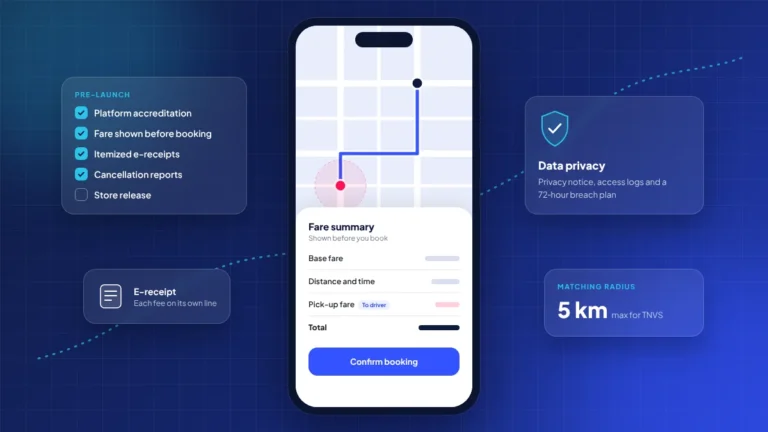
Matching rules affect safety too. As reported by GMA News on July 19, 2026, the LTFRB set a maximum 5 km matching radius for TNVS alongside the fixed pick-up fare. Shorter pick-up distances mean shorter waits at the curb, which matters at night. For how matching works under the hood, see our sibling article Inside a Ride-Hailing App.
Driver distraction
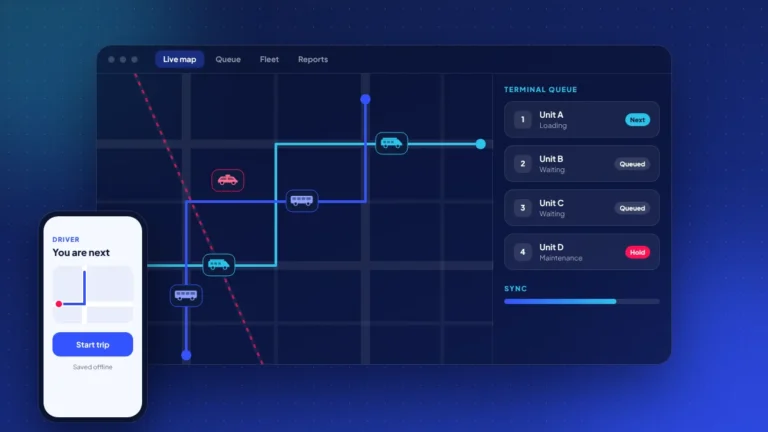
A driver staring at a phone is a safety risk. Design the driver app around glanceable cards, voice prompts and large buttons, and limit interactions while the vehicle is moving. AutoIndustriya reported in July 2026 that the LTFRB was finalizing a ban on vlogging or livestreaming while driving a PUV, with a ₱5,000 fine and possible revocation. That rule was still pending, but your driver code of conduct can already prohibit it.
Is GPS or CCTV mandatory?
In our research we found no 2025–2026 news reports of a new GPS or CCTV mandate for ride-hailing or PUVs. GPS tracking during trips is still standard practice because the app needs it to work. In-car cameras are a different matter, covered below.
Fare transparency is a safety feature
Disputes over money are a common trigger for conflict in a vehicle. Showing the fare clearly before the trip removes much of that tension. According to GMA News and Daily Tribune, the 2026 TNVS pick-up fare rules require the pick-up fare to be shown separately before booking and on the receipt. For app-booked taxis, Philstar reported that MC 2026-055 caps the booking fee at the lower of 20% of the fare or ₱60, which must also be disclosed before booking and itemized.
Cancellations are part of this. Top Gear Philippines reported on December 12, 2025 that driver cancellations of TNVS bookings are treated as refusal to convey under MC 2025-055, with escalating penalties. A passenger left stranded late at night is a safety issue, so cancellation tracking is not just a compliance report.
Cashless payments: fewer disputes, less cash on board
Paying in-app or by QR means the driver carries less cash and the passenger does not argue about change. Filipino passengers are increasingly ready for it:
- Digital payments made up 64.7% of retail payment volume in 2025, according to the BSP’s report as covered by Daily Tribune on August 19, 2026. That compares with 57.4% in 2024 and 52.8% in 2023.
- QR Ph handled about 2.47 billion transactions worth ₱1.16 trillion in 2025, overtaking cards, according to the same report.
- GCash reported 90 million registered users and about 39 to 40 million monthly active users for 2025 in its parent Mynt’s IPO filing announcement of June 27, 2026.
Keep cash as an option, because many passengers still rely on it, but make cashless the default and the easiest path. Our guides to GCash and Maya payments and the payment gateway stack for mobile apps explain the integration choices.
Privacy limits: what safety features must not do
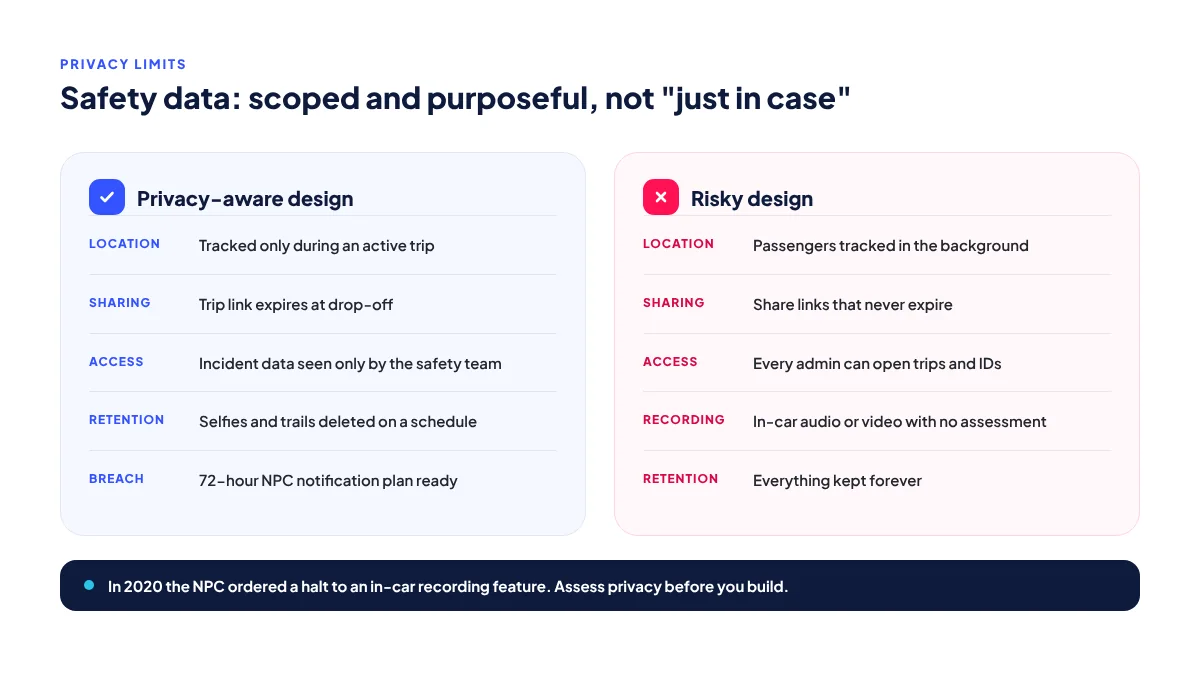
Safety features collect sensitive data: precise location, faces, voices and contact lists. The Data Privacy Act of 2012 (RA 10173) applies to all of it. The clearest Philippine precedent came in February 2020, when the NPC ordered Grab to halt a passenger selfie and in-car audio and video recording feature, as reported by NewsBytes.PH. Grab said the feature was lawful but complied with the order. That case is historical, but the lesson remains: a safety purpose does not automatically justify any amount of data collection.
Design rules we apply to safety features:
- Trip-scoped data. Track passenger location only during an active trip. Share links and proxy numbers expire at drop-off.
- Least access. Only the safety team sees incident data. Broken access control is the top risk in the OWASP Top 10:2025, and a leaked trip-share endpoint can expose someone’s home address.
- Retention limits. Delete driver shift selfies and detailed location trails on a schedule, keeping only what disputes and regulators require.
- Breach readiness. Under NPC Circular 16-03, personal data breaches must be reported within 72 hours. Have the plan and contact list ready before launch.
A safety feature that leaks a passenger’s home address has made the passenger less safe, not more.
Our Data Privacy Act guide for websites and apps covers privacy notices and consent in more detail.
Passenger safety feature checklist
Use this as a build and review checklist for your passenger and driver apps:
- Driver documents reviewed and logged, with automatic suspension on expiry.
- Each driver account bound to one verified vehicle; plate shown prominently to passengers.
- Optional shift-start identity check with consent and short retention.
- Fare, pick-up fare or booking fee shown before booking and itemized on the e-receipt.
- Live trip sharing with links that expire at drop-off.
- SOS button reachable in one tap, sending trip ID and location to a staffed safety queue.
- Route deviation and long-stop alerts during active trips.
- Masked calls and chat between passenger and driver.
- Cashless payment as the default, with cash still available.
- Incident reports routed to a restricted team with response time targets.
- Driver app designed to minimise screen use while moving.
- Privacy impact assessment, retention schedule and 72-hour breach plan documented.
Current rules versus good practice
It helps to keep two lists separate. Items reported as in force in 2026 include the fixed TNVS pick-up fare and 5 km matching radius, the taxi booking fee cap, cancellation-as-refusal-to-convey, and the motorcycle taxi pilot rules on one rider per unit and app-only booking. Pending items include the vlogging ban. Everything else in this article, such as trip sharing, SOS buttons and masked calling, is good practice rather than a reported legal requirement. None of it grants authority to operate; for that, see our ride-booking app compliance checklist and confirm with the LTFRB.
Frequently asked questions
Can a ride app record audio or video inside the car?
Only with great care. In 2020 the NPC ordered Grab to halt a passenger selfie and in-car recording feature. Any such feature needs a privacy impact assessment, a clear purpose, notice to users and legal review.
How long should trip-sharing links stay active?
Only for the duration of the trip. Expire the link at drop-off so contacts cannot keep tracking the passenger afterward.
Is cash still needed in a Philippine ride app?
Yes for many users. Digital payments reached 64.7% of retail payment volume in 2025, which also means a sizeable share is still non-digital. Offer both, with cashless as the default.
What should an SOS button actually do?
Send the trip ID, driver details and live location to a staffed safety team and, if the passenger chooses, to a trusted contact, with a clear option to call emergency services.
Are GPS trackers required in ride-hailing vehicles?
We found no 2025–2026 reports of a new GPS mandate. Ride apps already use the driver’s phone GPS during trips. Confirm any vehicle equipment requirements with the LTFRB.
Sources
Researched October 26, 2026. Dates show when each source was published.
- LTFRB MC taxi rules: allowed bikes, 60 km/h limit and more, Motopinas, July 7, 2026.
- LTFRB serves show-cause orders on ride-hailing firms amid widening TNVS probe, DZRH, May 6, 2026.
- LTFRB brings back fixed pick-up fare policy for TNVS, GMA News, July 19, 2026.
- LTFRB rules set fixed TNVS pick-up rates, Daily Tribune, July 19, 2026.
- LTFRB caps app-booked taxi fees at P60, Philstar, July 18, 2026.
- LTFRB memo on TNVS booking cancellations, Top Gear Philippines, December 12, 2025.
- LTFRB bans PUV drivers from vlogging while driving, AutoIndustriya, July 6, 2026.
- BSP: Digital payments account for nearly two-thirds of retail volume, Daily Tribune, August 19, 2026.
- Philippine digital payments in 2024, BitPinas, July 14, 2025.
- Digital payments share in 2023, Philippine News Agency, July 23, 2024.
- GCash parent Mynt submits SEC registration statement for proposed IPO, Mynt, June 27, 2026.
- Grab PH says passenger selfie, recording lawful but will follow NPC halt order, NewsBytes.PH, February 6, 2020.
- NPC Circular 16-03: Personal Data Breach Management, National Privacy Commission, 2016.
- OWASP Top 10:2025 Introduction, OWASP Foundation, 2025.