13 min read
Before you launch a ride-booking app in the Philippines, separate two questions: is the software ready, and is anyone legally allowed to run the service on it? Building an app never grants authority to operate a public transport service. Your launch checklist therefore covers platform accreditation and operator authority with the LTFRB, fare transparency features required by 2025–2026 circulars, receipts and cancellation reporting, Data Privacy Act duties, and app store rules.
This guide is written for founders, transport operators and cooperatives who are about to commission or launch a ride-booking platform. It focuses on what the product must do and what paperwork must exist before the first paid trip. It is a practical checklist, not legal advice: rules change often, and the LTFRB’s own website was unreachable when we researched this article, so every regulatory item below comes from reputable Philippine news reports of LTFRB and DOTr statements. Confirm the current text of each circular with the LTFRB or a transport lawyer before you go live.
Start here: an app is not a franchise
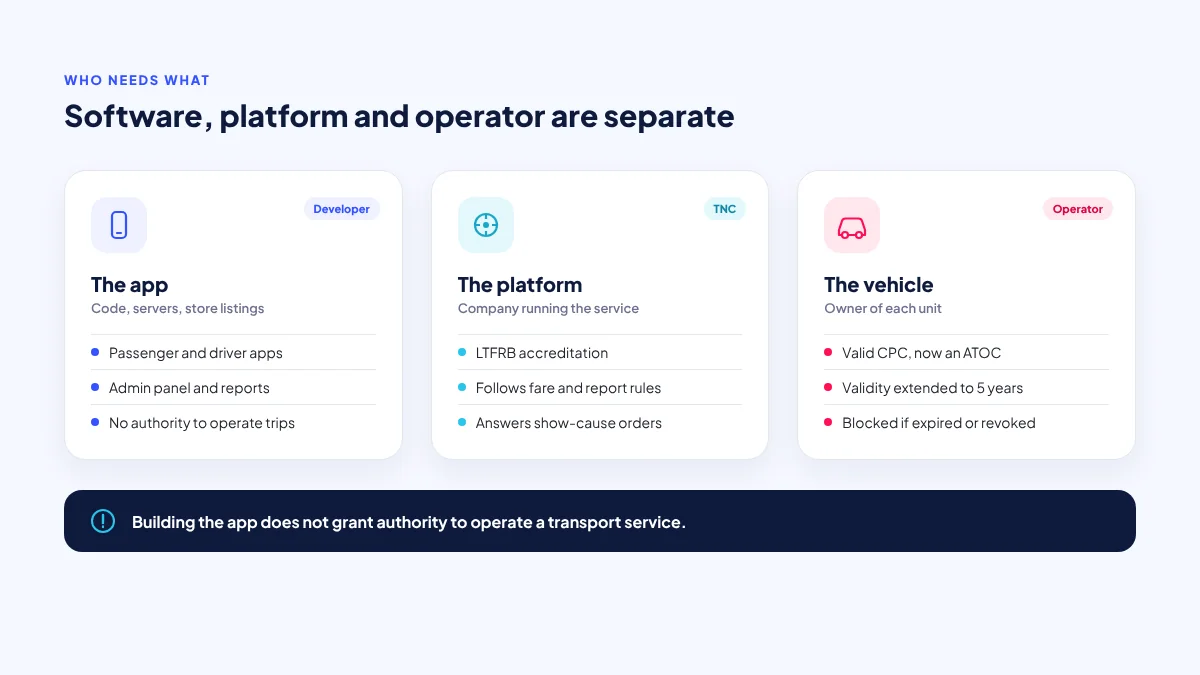
The most expensive mistake we see in ride-hailing projects is treating the app as the business licence. In the Philippine setup, the parties are distinct:
- The transport network company (TNC) runs the platform that connects passengers and drivers. TNCs are accredited by the LTFRB.
- The operator owns or controls the vehicle and holds the authority to operate it as a transport network vehicle service (TNVS).
- The software developer, which may be an agency like ServicioPro or your own team, builds and maintains the code. A developer has no regulatory standing to operate trips.
Accreditation is also not a one-time event. As reported by Daily Tribune on February 27, 2026, the LTFRB suspended three ride-hailing firms for 12 months over non-compliance, ignoring show-cause orders and having no active platform. A platform that launches and then goes dormant, or does not answer the regulator, can lose its standing.
| Party | What it needs (as reported) | Status |
|---|---|---|
| TNVS platform (TNC) | LTFRB accreditation; ongoing compliance with circulars and responses to show-cause orders | In force |
| TNVS operator | Valid CPC, which MC 2026-049 automatically converts into an Authority to Operate Certificate (ATOC) without a renewal filing; validity extended to five years; expired, revoked or suspended CPCs are excluded | In force (advisory July 14, 2026) |
| Motorcycle taxi platform | Accreditation under the DOTr pilot framework; the LTFRB opened accreditation on August 5, 2026 with “no new players” | Pilot framework; a motorcycle taxi law is pending in Congress |
| Software developer | No transport authority. Contractual and data privacy obligations only | Not applicable |
For the TNVS conversion, Inquirer and Philstar reported that valid certificates are converted automatically and that the conversion covers electric vehicles too. For motorcycle taxis, GMA News reported that the accreditation window opened on August 5, 2026 for existing pilot participants only, and on October 12, 2026 that two applicants were denied for failing to prove continued pilot operation. If your plan is a brand-new motorcycle taxi brand, that door is currently closed.
Layer 1: Fare transparency features
Several 2025–2026 rules are, in practice, product requirements. If your fare engine cannot show these items correctly, the platform is not ready.
TNVS pick-up fare
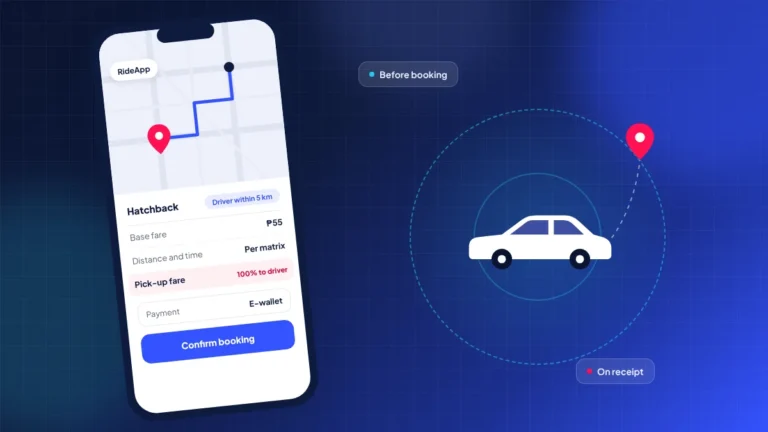
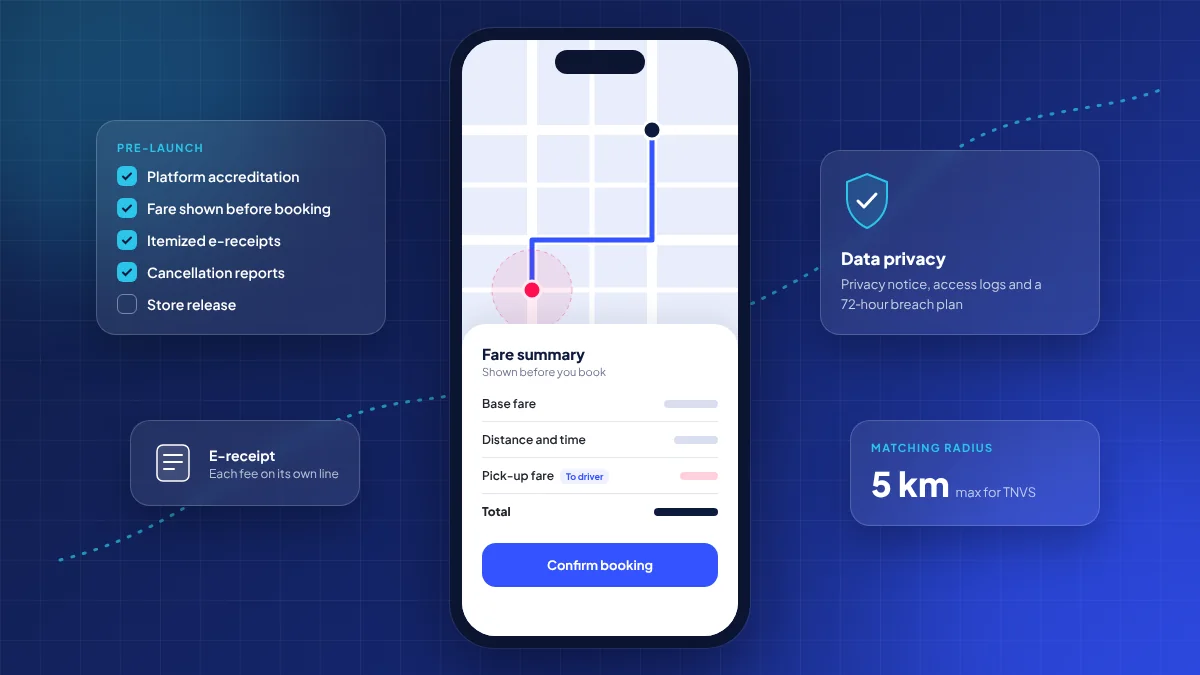
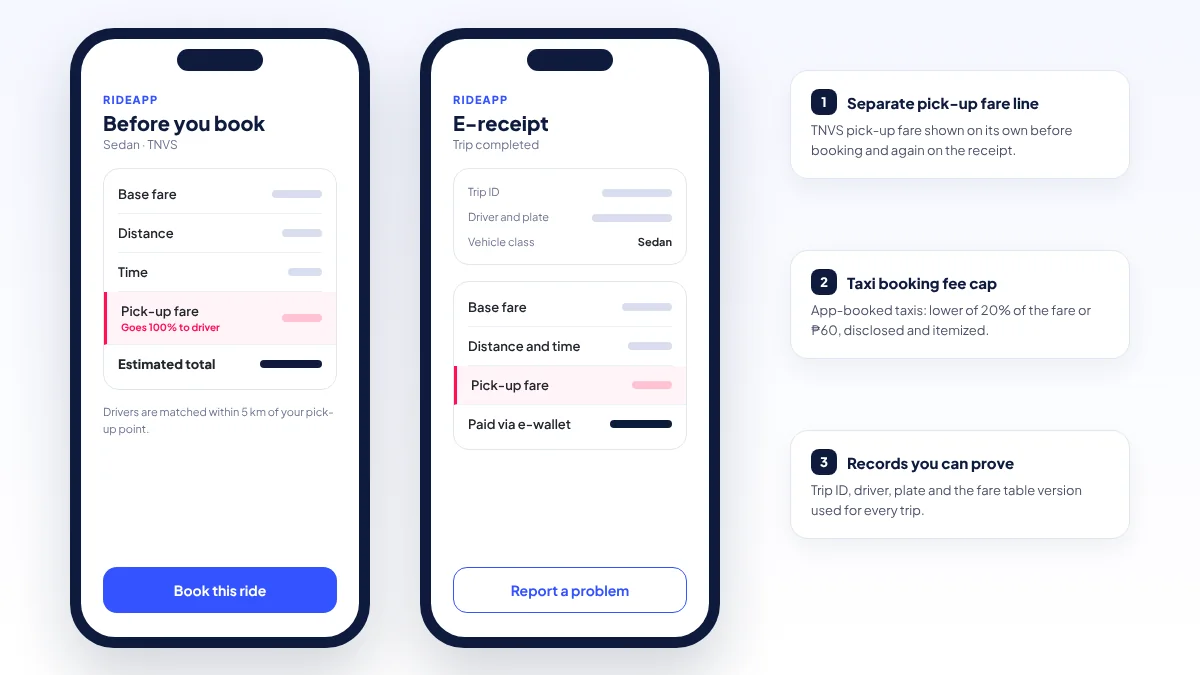
According to GMA News and Daily Tribune (July 19, 2026), the LTFRB made a fixed TNVS pick-up fare permanent after first using it temporarily in December 2025. Reported details: the pick-up fare ranges from ₱24–₱120 for hatchbacks up to ₱58–₱289 for premium vehicles, scaled to pick-up distance up to 5 km; the maximum matching radius is 5 km; the pick-up fare goes 100% to the driver with no commission; and it must be shown separately before booking and on the receipt. Reports cite different circular numbers for this rule, so check the exact reference with the LTFRB.
What that means for the build:
- A pick-up fare table per vehicle class, editable by an admin without an app release.
- Matching logic that never offers a trip to a driver beyond 5 km.
- A separate line in the pre-booking fare summary and on the e-receipt.
- Commission logic that excludes the pick-up fare from the platform’s share.
App-booked taxi booking fee
If your platform also books regular taxis, Philstar reported on July 18, 2026 that MC 2026-055 caps the app booking fee at the lower of 20% of the fare or ₱60. The fee must be disclosed before booking and itemized on the receipt. The cap applies to app-booked taxis, not TNVS, so your pricing engine needs to know which service type each trip belongs to.
Base fares and fast updates
New TNVS base fares took effect on September 28, 2026 along with other public transport fare changes. On October 1, 2026, Daily Tribune reported that the LTFRB issued show-cause orders to 19 ride-hailing firms for not implementing the fare increase, with a hearing set for October 7. That case is pending, but the lesson is clear: fares must be configuration, not code. A platform that needs a full app store release to change a fare will always be late.
Surge controls
For the 2025 holiday season, MC 2025-056 capped TNVS surge at 1x and barred commission on surge between December 17, 2025 and January 4, 2026, as reported by Inquirer and GMA News. That rule has lapsed and is historical, but it shows that regulators can switch surge off for a period. Build an admin control that caps or disables surge by date range and region.
| Rule (as reported) | Feature your app needs | Status |
|---|---|---|
| Fixed TNVS pick-up fare, 5 km max matching radius | Pick-up fare table, radius limit in matching, separate fare line, no commission on pick-up fare | In force |
| Taxi booking fee: lower of 20% of fare or ₱60 (MC 2026-055) | Fee calculator by service type, pre-booking disclosure, itemized receipt | In force |
| Fare adjustments effective September 28, 2026 | Admin-editable fare tables with effective dates | In force; show-cause case pending |
| Holiday surge cap at 1x (MC 2025-056) | Date-ranged surge caps and commission switches | Historical |
Layer 2: Receipts and trip records
Itemized fares before booking and itemized e-receipts after the trip recur across the circulars above. A compliant receipt is also your best evidence when a passenger complains or a regulator asks questions. At minimum, design the e-receipt to show:
- Trip ID, date and time of request, pick-up and drop-off.
- Driver name, vehicle plate and vehicle class.
- Base fare, distance and time components, pick-up fare (TNVS) or booking fee (taxi) as separate lines.
- Discounts, promo codes and the payment method used.
- A support contact and a way to report a problem with this specific trip.
Store the fare table version used for each trip. When fares change on a set date, you will need to prove which rates applied to which trips.
Layer 3: Cancellations and monthly reporting
As reported by Top Gear Philippines on December 12, 2025, MC 2025-055 treats TNVS booking cancellations by drivers as refusal to convey under existing joint administrative rules, with penalties of ₱5,000, ₱10,000 and ₱15,000 and possible cancellation of the operator’s certificate. TNCs are reported to be required to submit monthly cancellation reports.
Your platform should therefore:
- Log every cancellation with who cancelled, when, at what stage, and the reason selected.
- Distinguish passenger cancellations, driver cancellations and system timeouts.
- Generate a monthly export grouped by driver, operator and vehicle.
- Flag repeat driver cancellations so operators can act before penalties pile up.
Layer 4: Driver onboarding and conduct
On May 6, 2026, DZRH reported that the LTFRB served show-cause orders on ride-hailing firms over alleged TNVS onboarding “fees” of ₱25,000 to ₱90,000 and around 230,000 questionable entries, with hearings in mid-May. The probe is pending, so do not treat the allegations as findings. For a new platform, the takeaway is to make onboarding auditable:
- Record every document submitted, who reviewed it and when it was approved.
- Link each driver account to one verified operator and one vehicle record.
- Never let third parties create driver accounts outside your own audited flow.
- Show drivers clearly that onboarding fees, if any, are only those your company publishes.
For motorcycle taxis under the pilot framework, Motopinas reported that LTFRB MC 2026-048 requires bikes of at least 100cc (or 1.5 kW electric), a 60 km/h limit with a passenger, one rider per unit with no relievers, app-only bookings with no street hail, helmets, and the discounts under RA 10699. In product terms, that means one-to-one rider and bike binding and no manual “walk-in” trips. Separately, a proposed ban on vlogging or livestreaming while driving a PUV was being finalized in July 2026; it is pending, but a driver code of conduct can already cover it. Our rider supply and onboarding playbook covers the operational side.
If a regulator asks how a driver got onto your platform, the answer should be a single audit trail, not a group chat.
Layer 5: Data privacy from day one
Ride apps process location trails, phone numbers, IDs and payment data, so the Data Privacy Act of 2012 (RA 10173) applies to the TNC, and often to operators and the developer as a processor. Practical requirements:
- A privacy notice in plain language, shown at sign-up, that matches what the app actually collects.
- Collect only what each feature needs. Location while a trip is active is easy to justify; continuous background tracking of passengers is not.
- Role-based access in the admin panel, with logs of who viewed trip and ID data.
- A breach response plan. Under NPC Circular 16-03, personal data breaches must be notified within 72 hours.
History is a useful guide. In February 2020, the NPC ordered Grab to halt a passenger selfie and in-car audio and video recording feature, as reported by NewsBytes.PH. Safety features need a privacy assessment before launch, not after. See our Data Privacy Act guide for websites and apps and trust and safety for on-demand apps.
Layer 6: App store readiness
Store rules can delay a launch as much as regulation can:
- Google Play target API. From August 31, 2026, new apps and updates must target Android 16 (API 36), with an extension available to November 1, 2026, according to Google’s Android developer documentation.
- Android developer verification. Enforcement started September 30, 2026 in Brazil, Indonesia, Singapore and Thailand, with global rollout in 2027. The Philippines is not in the first wave, but plan your developer account verification now. Our post on Google Play location policy and developer verification explains the details.
- Age ratings. Apple moved to 13+, 16+ and 18+ age ratings and required developers to answer the new questionnaire by January 31, 2026. Google’s Play Age Signals API is rolling out globally later in 2026.
- Location permission disclosures. Both stores review why a driver app needs background location. Prepare the explanation and in-app disclosure before submission.
The pre-launch checklist
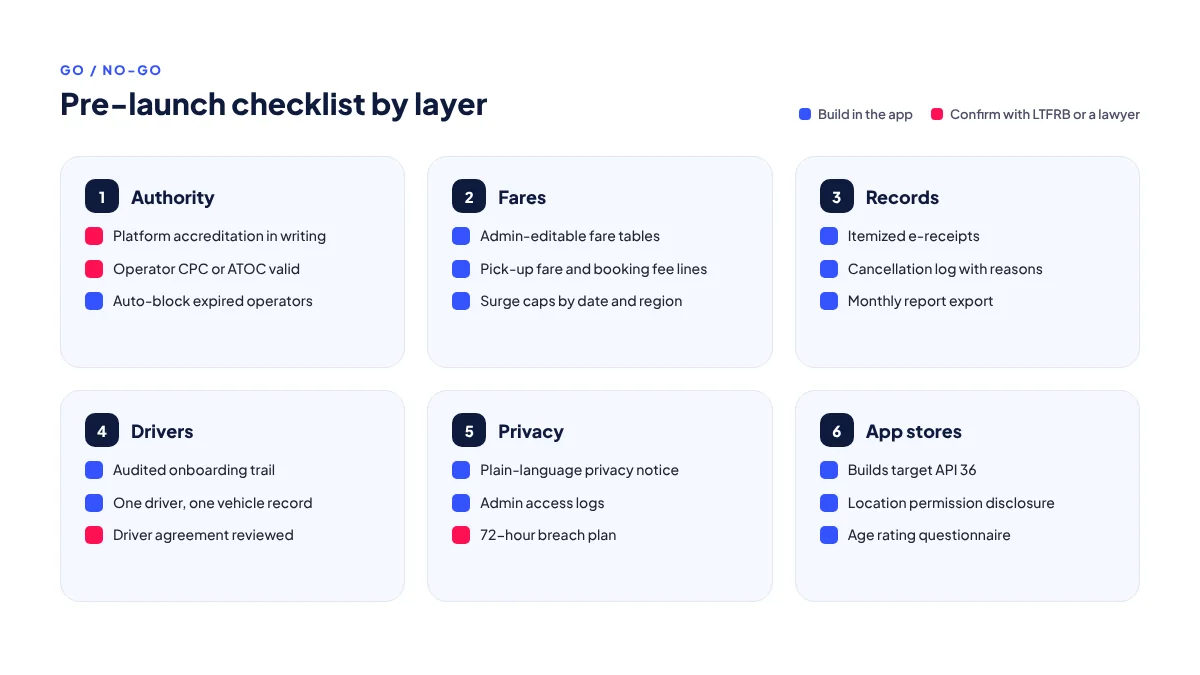
Use this list in your final go/no-go meeting. Every item should have an owner and evidence.
- Platform accreditation status confirmed in writing with the LTFRB.
- Every onboarded operator has a valid CPC or ATOC; expired, revoked or suspended ones are blocked automatically.
- Official email for LTFRB notices is monitored daily; the 2026 franchise renewal circulars (MC 2026-035 and MC 2026-038) require operators to keep a valid email as the official channel, according to AutoIndustriya.
- Fare tables, pick-up fares and booking fees are admin-editable with effective dates.
- Matching radius is capped at 5 km for TNVS.
- Pre-booking fare summary and e-receipt show each fee as its own line.
- Cancellation logs and the monthly report export are tested with sample data.
- Surge can be capped or disabled by date and region.
- Driver onboarding has a full audit trail with no off-platform account creation.
- Privacy notice, consent flows, access logs and a 72-hour breach plan are in place.
- App builds target API 36 and store listings have correct age ratings and location disclosures.
- Terms of service, driver agreements and refund policy reviewed by a lawyer.
Where the build fits
None of the regulatory items above can be solved by code alone, but code can make them much cheaper to manage. When ServicioPro builds a taxi booking app or a white-label ride platform, we treat fare tables, radius limits, cancellation logs and receipt formats as configurable modules from the first sprint, because rules in this sector have changed several times in a single year. For the technical side of matching and pricing, read our sibling article Inside a Ride-Hailing App, and for the regulatory detail, TNVS Rules in 2026.
Frequently asked questions
Can I launch my ride-booking app while waiting for LTFRB accreditation?
You can finish and test the software, including closed tests with your own staff, but taking paid public trips without the required authority is a regulatory risk. Confirm what is allowed with the LTFRB before any public launch.
Does the developer need an LTFRB licence?
No. The developer builds software. Accreditation is held by the platform company (TNC) and authority to operate is held by each operator. Building or owning an app does not grant authority to operate a transport service.
Do the pick-up fare rules apply to taxis?
As reported, the fixed pick-up fare applies to TNVS. App-booked taxis fall under a separate booking fee cap, the lower of 20% of the fare or ₱60, under MC 2026-055.
Can I start a new motorcycle taxi app in 2026?
Not as a new player under current reports. The accreditation window that opened on August 5, 2026 was described as having “no new players”, and a motorcycle taxi law is still pending in Congress. Watch for the law before planning a launch.
What data should a ride app avoid collecting?
Anything a feature does not need. Avoid always-on passenger tracking outside trips, unnecessary ID copies and in-car recording without a privacy assessment. The NPC halted a selfie and recording feature in 2020, which shows how closely these features are reviewed.
Sources
Researched October 26, 2026. Dates show when each source was published.
- LTFRB: TNVS CPCs to be automatically converted into ATOCs, Inquirer.net, July 14, 2026.
- LTFRB removes franchise renewal application requirement for TNVS, Philstar, July 16, 2026.
- LTFRB brings back fixed pick-up fare policy for TNVS, GMA News, July 19, 2026.
- LTFRB rules set fixed TNVS pick-up rates, Daily Tribune, July 19, 2026.
- LTFRB caps app-booked taxi fees at P60, Philstar, July 18, 2026.
- LTFRB summons 19 ride-hailing firms over unimplemented fare hike, Daily Tribune, October 1, 2026.
- LTFRB issues circular on surge pricing for TNVS, Inquirer.net, December 2025.
- LTFRB memo on TNVS booking cancellations, Top Gear Philippines, December 12, 2025.
- LTFRB suspends 3 ride-hailing firms over franchise violations, Daily Tribune, February 27, 2026.
- LTFRB serves show-cause orders on ride-hailing firms amid widening TNVS probe, DZRH, May 6, 2026.
- LTFRB MC taxi rules: allowed bikes, 60 km/h limit and more, Motopinas, July 7, 2026.
- LTFRB sets Aug. 5 opening of motorcycle taxi platform provider accreditation, GMA News, July 30, 2026.
- LTFRB rejects GrabBike, Dingdong RiderKo accreditation bids, GMA News, October 12, 2026.
- LTFRB removes hearings, newspaper notices for PUV franchise renewals, AutoIndustriya, May 21, 2026.
- LTFRB bans PUV drivers from vlogging while driving, AutoIndustriya, July 6, 2026.
- NPC Circular 16-03: Personal Data Breach Management, National Privacy Commission, 2016.
- Grab PH says passenger selfie, recording lawful but will follow NPC halt order, NewsBytes.PH, February 6, 2020.
- Meet Google Play’s target API level requirement, Android Developers, updated October 17, 2026.
- Android developer verification, Android Developers Blog, June 18, 2026.
- Apple notifies developers of new App Store age rating system, 9to5Mac, July 24, 2025.