10 min read
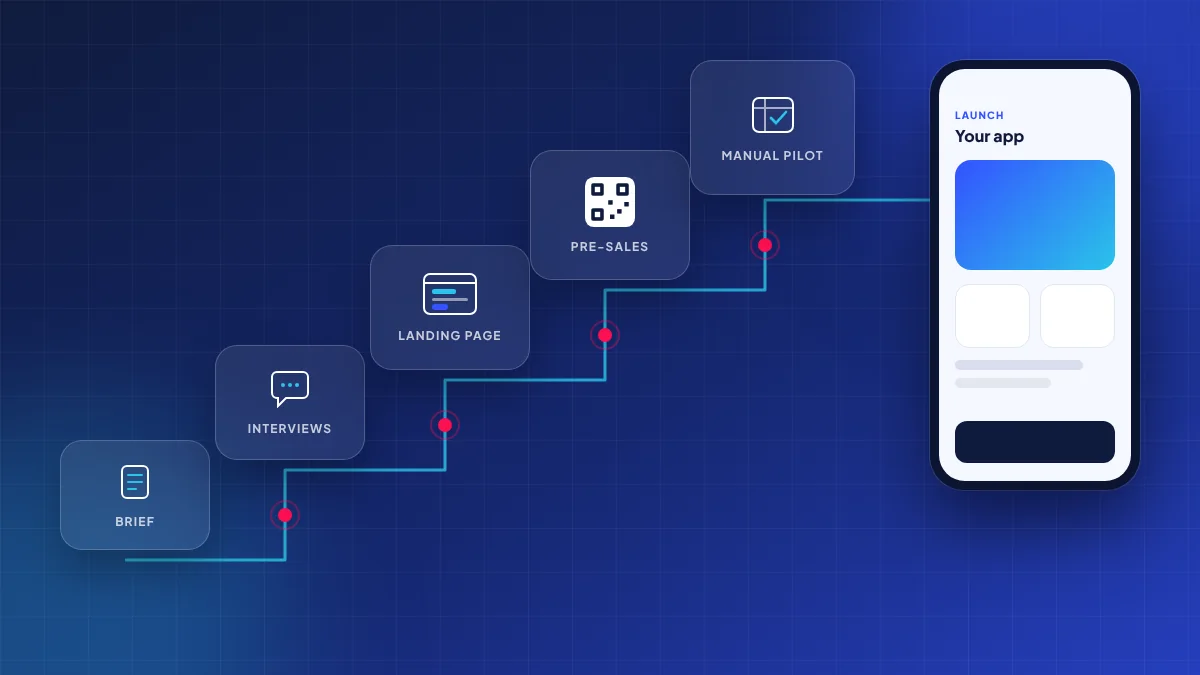
Validate an app or website idea before paying for a full build. Talk to likely customers, put up a simple landing page, ask for pre-orders or deposits, and run the service manually for a few weeks. Spend on software in stages, and release more budget only when each stage shows real demand. This keeps your first, most uncertain peso small and your biggest peso for an idea that has already proven itself.
Many Philippine app projects begin with a finished vision: a delivery app for a town, a booking app for a clinic, a marketplace for a niche. The vision is often good. The problem is the order of spending. Founders pay for a full app first and look for customers second. This guide reverses that order. It is not a development timeline (we cover that in our MVP timeline guide) and not a build process (see our app development process). It is a plan for deciding whether, and how much, to build at all.
Why validation saves more than it costs
Software cost is driven by scope: the number of user types (customer, merchant, driver, admin), the number of screens and workflows, integrations such as payments and maps, and the level of polish. Every feature you build for customers who never arrive is money you cannot spend on marketing or on the features real customers ask for. We cannot quote a market-wide average cost for apps in the Philippines because no credible public benchmark exists. What we can say is that validation activities cost a small fraction of a build, and they change what you build.
Validation answers three questions in sequence:
- Problem: Do enough people have this problem, often enough, to care?
- Demand: Will they take a small action, such as signing up or messaging, when offered a solution?
- Willingness to pay: Will they pay, or put down a deposit, before the full product exists?
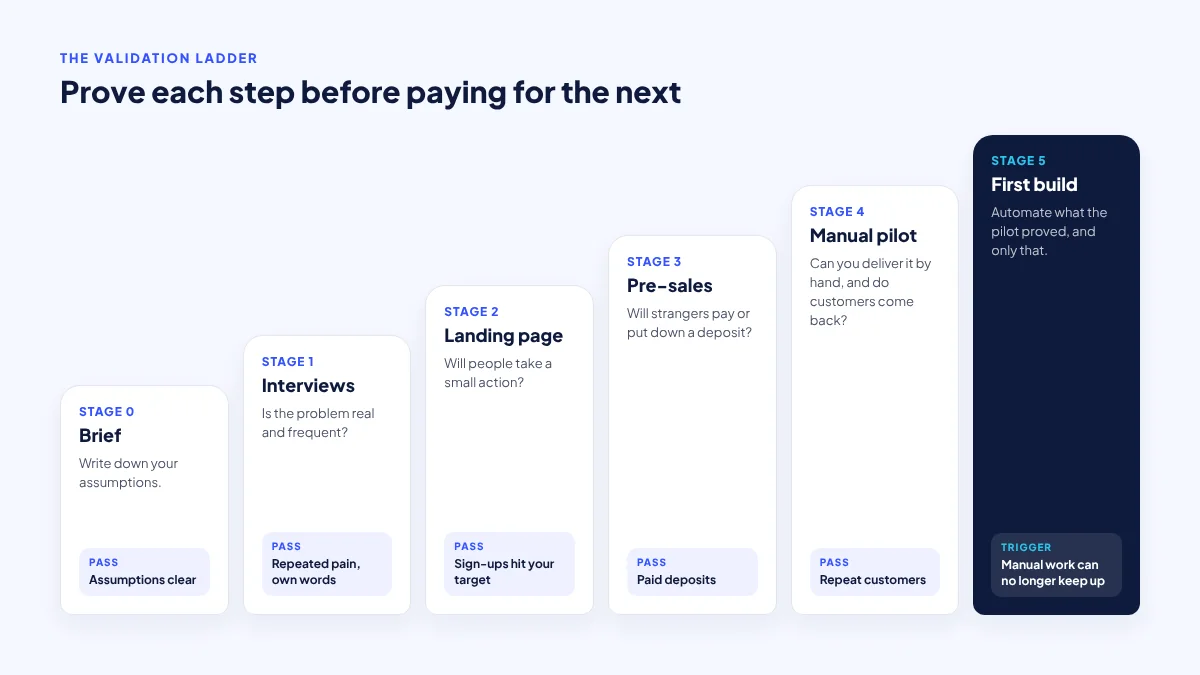
Stage 0: Write a one-page brief
Before talking to anyone, write down your assumptions. Who is the customer? What do they do today instead? What will they pay, and how? Who else must join for it to work, such as riders, merchants or clinics? A written brief keeps you honest when the interviews start. Our website and app development brief template gives you a structure you can reuse later with a developer.
Stage 1: Talk to customers, not friends
Interview people who match your target customer and who owe you nothing. In a Philippine context that might mean sari-sari store owners, tricycle operators, clinic receptionists or office workers in a specific business district. Good interview habits:
- Ask about past behaviour, not future intentions. “When did you last order lunch delivery? How?” beats “Would you use my app?”
- Ask what they spend today, in time and money, on the problem.
- Note the exact words they use. They become your landing page copy.
- Stop pitching. If you are talking more than they are, you are selling, not learning.
The pass signal for this stage is a clear, repeated pain described in the customer’s own words, plus a group of people who ask to be told when you launch.
Stage 2: Test demand with a landing page
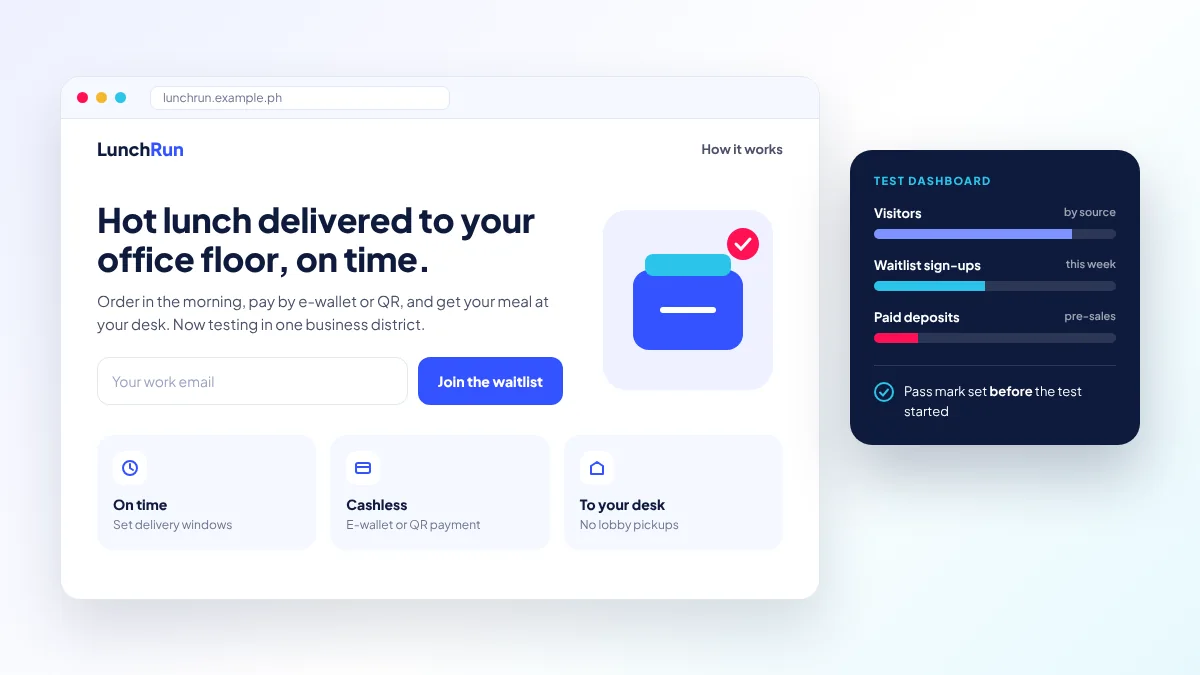
A landing page is a single web page that describes your offer as if it already exists and asks the visitor to do one thing: join a waitlist, request a quote or book a slot. Keep it simple:
- A headline in the customer’s words, describing the outcome, not the technology.
- Three or four benefits, a simple “how it works” and, if you can, a realistic price.
- One call to action, such as a sign-up form, a Messenger or Viber link, or a booking form.
- Basic analytics so you can count visitors and conversions by source.
Mobile matters most. DataReportal’s Digital 2026 report counts 98.0 million internet users in the Philippines, or 83.8% of the population, and most of them browse on phones. Test the page on a mid-range Android phone over mobile data, not just on office Wi-Fi.
Where the traffic comes from
Do not wait for organic search to validate an idea; it is too slow and, increasingly, less predictable. A Pew Research Center study of US users, published on July 22, 2025, found that Google users clicked a result link in 8% of visits when an AI summary appeared, compared with 15% when it did not. For a quick test, use small paid campaigns on the social platforms your customers use, posts in relevant community groups, and direct outreach to people from your interviews. Organic SEO is still worth building for the long term; our local SEO guide covers that.
Stage 3: Ask for money
Sign-ups are cheap; payments are honest. Pre-sales take many forms: a refundable deposit for early access, a discounted first month for a subscription service, or paid bookings for a service you will deliver manually at first.
Collecting payment is now easy for most Filipino customers. Digital payments made up 64.7% of retail payment volume in 2025, according to the BSP’s report as covered by Daily Tribune on August 19, 2026, and QR Ph overtook cards. You can accept deposits through e-wallets or QR Ph without a full app. Our guide to GCash and Maya payments for websites and apps explains the options.
Two cautions. First, be clear about refunds and delivery dates, and keep your promises. Second, if you sell goods or services online, the Internet Transactions Act (RA 11967) and its implementing rules apply to online merchants. Check the law and its implementing rules, or ask a lawyer; this is not legal advice.
Stage 4: Run it manually first
A “concierge” or manual pilot delivers the service with no custom software. A food delivery idea can start with a Facebook page, a Google Form and a group chat with three riders. A clinic booking idea can start with a shared calendar and a Viber number. You do the matching, scheduling and reminders by hand.
The manual pilot teaches you things no interview can:
- Which steps take the most time, and therefore deserve automation first.
- Where customers drop off or complain.
- What the real unit economics look like: delivery time, cancellations, payment collection.
- Which features nobody asked for, and can be cut from the first build.
If the service is regulated, a manual pilot does not exempt you. Transport services in particular need the proper authority from the LTFRB; building or piloting an app does not grant it. See our ride-booking app compliance checklist if your idea involves passengers.
Budgeting by stage
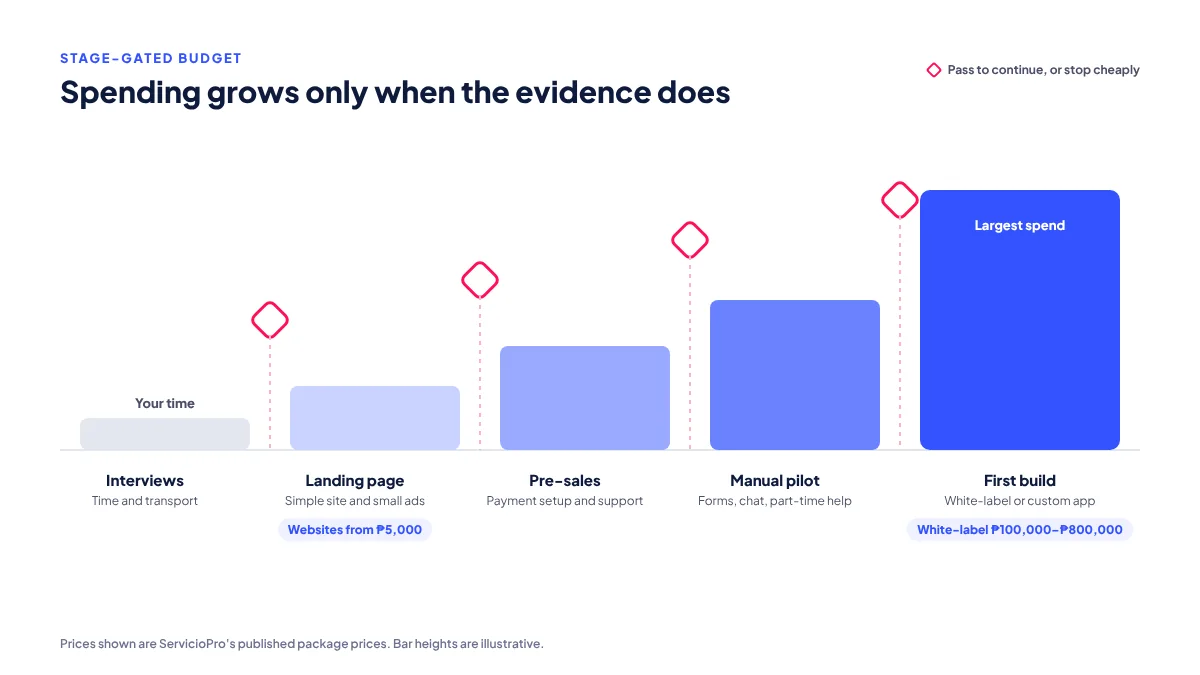
Here is how spending typically grows through the stages. The ServicioPro prices shown are our own published starting prices; other costs depend on your scope.
| Stage | What you spend on | Pass signal before moving on |
|---|---|---|
| 0. Brief | Your time | Clear assumptions written down |
| 1. Interviews | Time, transport, small thank-you gifts | Repeated pain in customers’ own words |
| 2. Landing page | Simple page or business website (ServicioPro packages from ₱5,000), small ad budget | Sign-up rate at or above your pre-set target |
| 3. Pre-sales | Payment setup, customer service time | Paid deposits or bookings from strangers |
| 4. Manual pilot | Forms, chat tools, part-time staff or riders | Repeat customers and workable unit economics |
| 5. First build | White-label app (ServicioPro: ₱100,000–₱800,000 depending on scope) or a custom MVP quoted by module | Pilot volume that manual work can no longer handle |
White-label apps suit common models such as food delivery, ride-hailing or booking, where a proven base can be branded and configured. Custom builds suit unusual workflows. Our comparison of white-label apps and custom builds goes deeper.
Spend your first peso on proof, not on code. The code gets better when the proof comes first.
Choosing the technology after validation
Only now does the technology question matter, and your pilot will usually answer it:
- A website or web app is enough when customers act occasionally, such as booking or ordering a few times a month.
- A progressive web app can work for repeat use without app store friction.
- A native or cross-platform mobile app makes sense when you need background location, push notifications at scale, or daily use. Your developer should explain the trade-offs for your specific use case.
Store and compliance readiness
If you go mobile, plan for store requirements. From August 31, 2026, new apps and updates on Google Play must target Android 16 (API level 36), with an extension available to November 1, 2026, according to Google’s Android developer documentation. Google’s developer verification rules began enforcement on September 30, 2026 in Brazil, Indonesia, Singapore and Thailand, with global rollout in 2027; the Philippines is not in the first wave. Any app that handles personal data must also comply with the Data Privacy Act.
After launch: keep budget for the boring parts
Many founders spend the whole budget on the build and nothing on what follows. Reserve money for:
- Maintenance: security updates, server costs, store requirement changes and bug fixes. Ask for a written maintenance scope before launch.
- Marketing: the channels that worked in your landing page test, scaled up carefully.
- Customer support: someone has to answer the chat.
- Iteration: the second and third versions, shaped by real usage data.
Your validation checklist
- One-page brief with written assumptions.
- Interviews with target customers who are not friends or family.
- Pass marks set in advance for each stage.
- Landing page tested on a mid-range phone over mobile data.
- Small, tracked traffic test from the channels your customers use.
- Deposits or paid bookings collected with clear refund terms.
- Manual pilot run long enough to see repeat customers.
- Feature list cut to what the pilot proved necessary.
- Build approach chosen: website, PWA, white-label or custom.
- Budget reserved for maintenance, marketing and support.
Frequently asked questions
How long should validation take?
It depends on your market, but each stage should be short and time-boxed. Set a deadline and a pass mark for each stage so validation does not become an excuse to delay.
Is a Facebook page enough instead of a landing page?
It can work for a manual pilot, but a landing page gives you cleaner tracking of visits and sign-ups, and you own it. Many founders use both.
What if someone copies my idea while I validate?
Execution and customer relationships are harder to copy than ideas. Validation also builds your early customer list, which is an advantage a copier will not have.
When should I stop and drop the idea?
When a stage misses its pre-set pass mark and changes to the offer, price or audience do not fix it. Stopping after a cheap test is a good outcome, not a failure.
Can ServicioPro help with validation, not just the build?
Yes. We can build a landing page or starter website for your test and later scope a white-label or custom app based on what your pilot proves.
Sources
Researched October 26, 2026. Dates show when each source was published.
- Digital 2026: The Philippines, DataReportal, November 5, 2025.
- Google users are less likely to click on links when an AI summary appears in the results, Pew Research Center, July 22, 2025.
- BSP: Digital payments account for nearly two-thirds of retail volume, Daily Tribune, August 19, 2026.
- President Marcos signs Internet Transactions Act, DTI, December 5, 2023.
- Meet Google Play’s target API level requirement, Android Developers, updated October 17, 2026.
- Android developer verification, Android Developers Blog, June 18, 2026.