9 min read
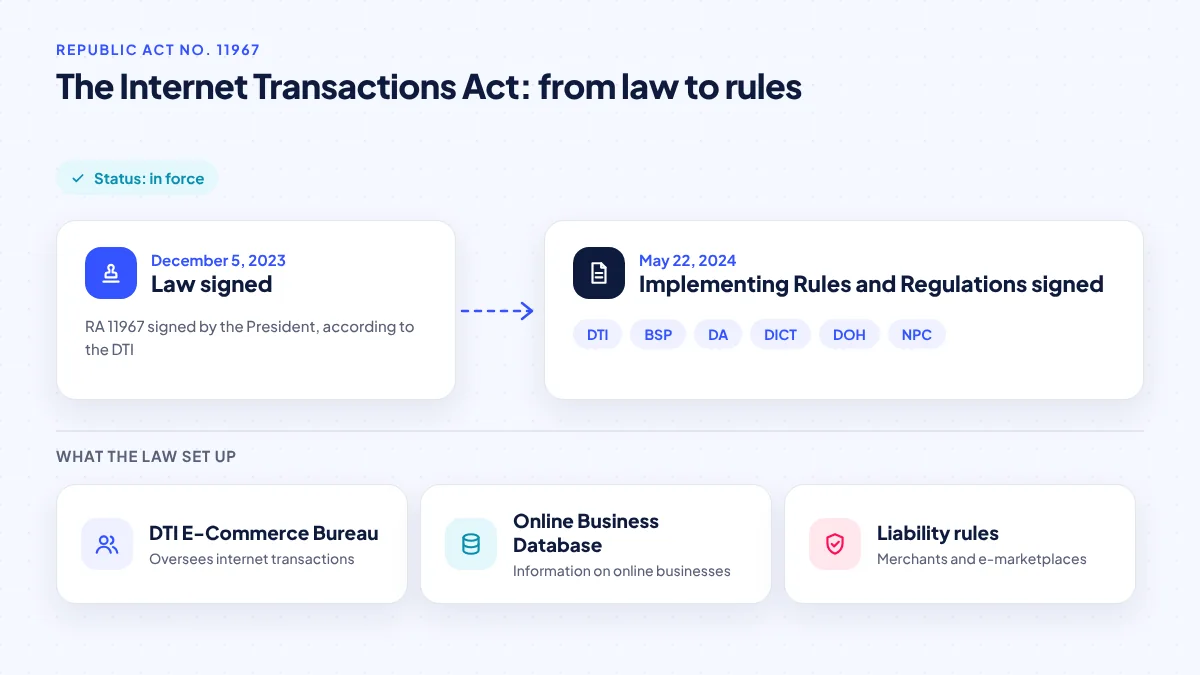
The Internet Transactions Act of 2023 (Republic Act No. 11967) is a law in force that governs business-to-consumer and business-to-business transactions conducted over the internet in the Philippines. It created a DTI E-Commerce Bureau and an Online Business Database, and it sets out the liability of online merchants and e-marketplaces; its Implementing Rules and Regulations (IRR) were signed on May 22, 2024. If you are building or running an online store, design it so that your identity, prices, terms, payments and customer data handling are clear and documented.
This guide explains the law’s key points as reported by the Department of Trade and Industry, then translates them into website features and processes. It is informational only and not legal advice: read the IRR and consult a lawyer or the DTI about your specific obligations.
What the Internet Transactions Act is
President Marcos signed the Internet Transactions Act on December 5, 2023, according to the DTI. The law aims to build trust in online commerce by making it clearer who is selling, what the rules are, and who is accountable when things go wrong. The DTI highlights three main elements:
- The E-Commerce Bureau within the DTI, which oversees internet transactions and coordinates with other agencies.
- An Online Business Database, intended to make information about online businesses available to consumers.
- Rules on liability for online merchants, e-retailers and e-marketplaces, so that platforms as well as sellers have responsibilities.
The IRR was signed on May 22, 2024, in an interagency signing led by the DTI with the Bangko Sentral ng Pilipinas, the Department of Agriculture, the DICT, the Department of Health and the National Privacy Commission. That list of agencies is telling: online commerce touches payments, food and agricultural products, technology, health products and personal data. The full IRR is available from the DTI and is the document to read for detailed obligations.
Where the ITA fits with other laws
The ITA does not replace earlier rules; it sits alongside them. A Philippine online store typically has to consider:
| Law or rule | What it covers for an online store | Status |
|---|---|---|
| Internet Transactions Act (RA 11967) and IRR | Internet transactions, online merchants and e-marketplaces, DTI E-Commerce Bureau, Online Business Database | In force (law signed Dec 5, 2023; IRR signed May 22, 2024) |
| Data Privacy Act (RA 10173) | Collection, use, storage and security of customer personal data; breach notification | In force |
| NPC Circular 16-03 | 72-hour notification of covered personal data breaches | In force |
| Consumer Act (RA 7394) | General consumer protection, product standards, fair trade practices | In force |
| Electronic Commerce Act (RA 8792) | Legal recognition of electronic documents, signatures and transactions | In force |
Sector rules can add more. Health products, food and regulated financial services each have their own regulators, which is why the DA, DOH and BSP joined the IRR signing.
Why this matters more as online selling grows
Online commerce is no longer a side channel. The Philippine Statistics Authority’s preliminary 2025 estimates put the digital economy at about ₱2.74 trillion, or 9.8% of GDP, with e-commerce accounting for 32.2% of it, as reported by GMA News on April 30, 2026. The DTI also reported onboarding 300,321 MSMEs to e-commerce between January 2023 and March 2024, according to Philstar.
More sellers means more competition for trust. In ServicioPro’s analysis, the features that support ITA and privacy compliance are the same ones that make shoppers comfortable buying from a store they have never heard of: a visible business identity, clear prices, honest delivery promises and reliable receipts.
Compliance and conversion point in the same direction: the clearer your store is about who you are and what the customer pays, the easier it is to say yes.
Payments: QR Ph, e-wallets and cards
Payment habits have shifted decisively. The BSP reported that digital payments made up 64.7% of retail payment volume in 2025, up from 57.4% in 2024, and that QR Ph handled 2.47 billion transactions worth ₱1.16 trillion, overtaking cards, as reported by the Daily Tribune on August 19, 2026. GCash alone reported 90 million registered users in 2025 in its parent Mynt’s IPO filing announcement.
For an online store, that means:
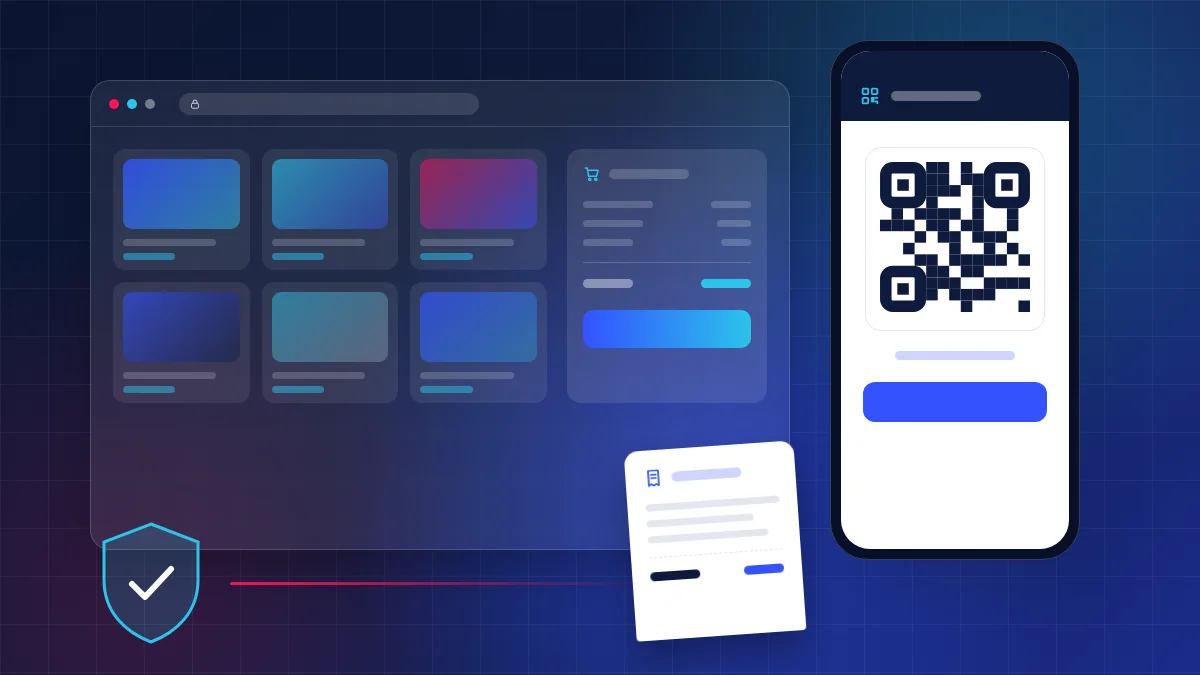
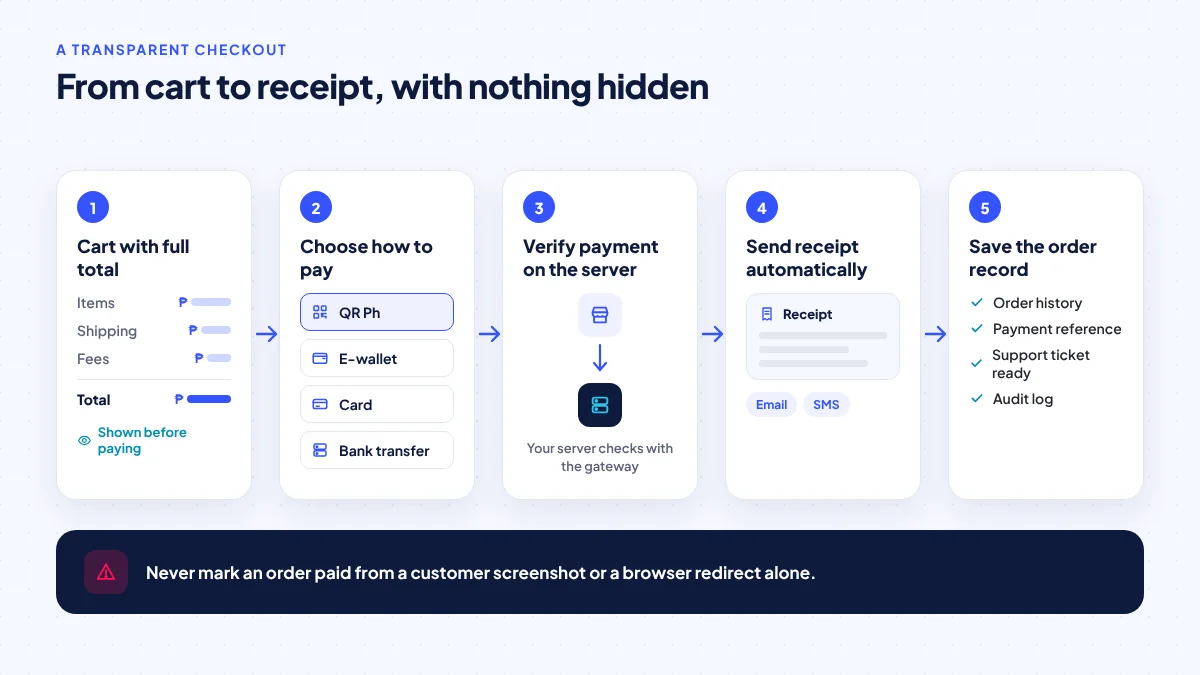
- Offer QR Ph and e-wallets, not just cards. A payment gateway can provide GCash, Maya, QR Ph, cards and bank transfers through one integration. See our guide to the payment gateway stack for Philippine apps.
- Confirm payments server-to-server. Mark an order paid only after your server verifies it with the gateway, never based on a customer’s screenshot or browser redirect alone.
- Show the total before payment. Product price, shipping, and any fees should be visible before the customer commits.
- Issue a receipt automatically. Send an order confirmation and receipt by email or SMS immediately after payment.
Our article on accepting GCash and Maya on your website or app explains setup in more detail.
Must-have features for an ITA-ready online store
The checklist below is ServicioPro’s recommended feature set. It reflects the law’s goals of transparency and accountability and general good practice; it is not an official compliance list.
Business transparency
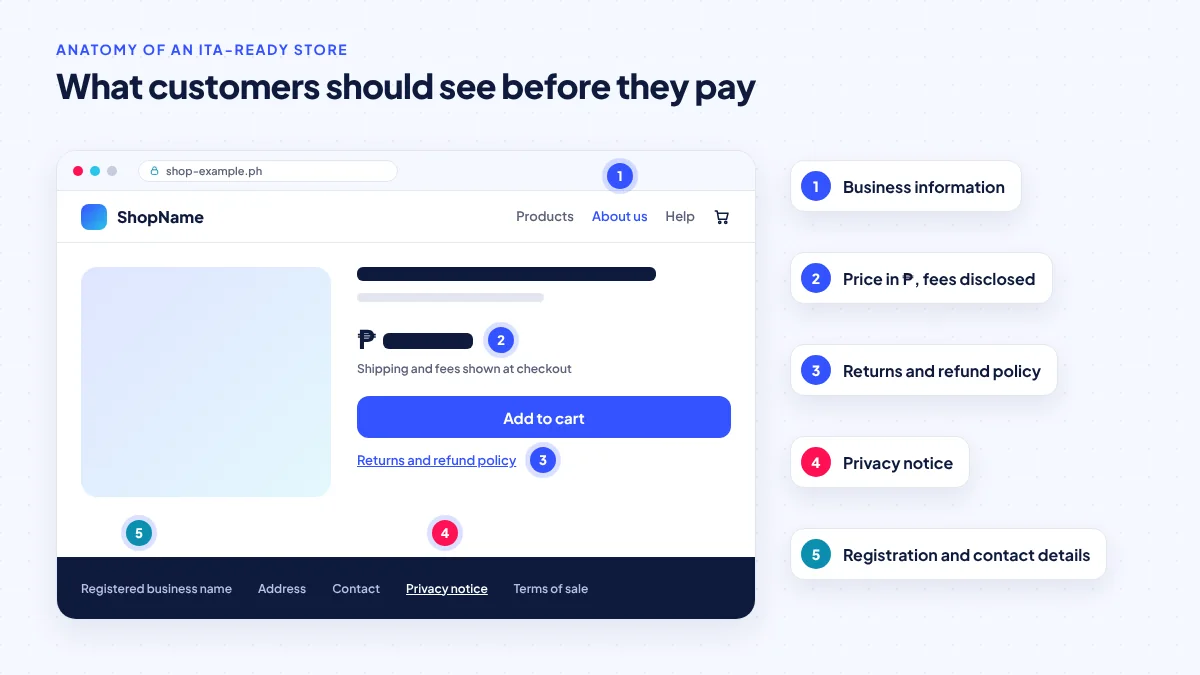
- An “About” or “Business information” page with your registered business name, DTI or SEC registration details, physical address, email and phone number.
- Consistent identity across your website, marketplace stores, social pages and invoices, so customers and regulators can match them.
- A visible customer support channel with expected response times.
Product and price clarity
- Accurate product descriptions, including size, variants, condition and what is included.
- Prices in pesos with shipping and any extra fees shown before checkout.
- Stock and lead times that match reality, especially for pre-orders and made-to-order items.
Terms and after-sales
- Clear terms of sale: delivery areas, timelines, cancellation rules.
- A returns, exchange and refund policy written in plain language and linked from every product page and the checkout.
- Order confirmation and receipts sent automatically, with an order history in the customer account.
- A complaint process with a ticket or reference number and records kept.
Privacy and security
- A privacy notice explaining what data you collect, why, who receives it (couriers, payment gateways) and how customers can exercise their rights.
- Consent and minimal collection: ask only for what you need to fulfil the order.
- Secure hosting, HTTPS, updates and backups, plus admin two-factor authentication.
- A breach response plan that can meet the NPC’s 72-hour notification rule.
Data privacy inside the store
Every order involves personal data: names, addresses, phone numbers and sometimes IDs. The Data Privacy Act applies regardless of the size of your shop. Practical steps:
- Limit admin access by role: packers see addresses, not payment details; marketing staff see aggregated data, not full customer lists.
- Do not store card numbers yourself; let the payment gateway handle them.
- Set retention rules: how long you keep order data, and when it is deleted or anonymised.
- Log admin exports and changes so you can investigate incidents.
- Review what you share with couriers and marketing tools.
For a full walkthrough, read our guide on Data Privacy Act compliance for websites and apps, and see the OWASP Top 10:2025 for Philippine businesses for the security side.
A practical build sequence
If you are commissioning a new store, build compliance in from the start rather than bolting it on:
- Gather your registration documents, business address and official contact details.
- Write your terms of sale, returns policy and privacy notice before design begins, so the layout makes room for them.
- Choose a payment gateway that supports QR Ph, e-wallets and cards, with server-side confirmation.
- Design product, cart and checkout pages to show full prices and fees.
- Set up automated receipts, order records and a support ticket process.
- Configure admin roles, two-factor authentication, logging and backups.
- Test the full journey on mobile, including failed and duplicate payments, returns and cancellations.
- Review the IRR and have a lawyer check your policies before launch.
Cost depends on the number of products, payment methods, integrations with couriers or accounting systems, and how much custom functionality you need. ServicioPro’s business website packages start from ₱5,000, and the website cost guide explains what moves the price up for e-commerce.
Frequently asked questions
Does the Internet Transactions Act apply to small sellers?
The law covers internet transactions generally, not just large platforms. How specific obligations apply to your business depends on the IRR and your situation, so check with the DTI E-Commerce Bureau or a lawyer.
Do I still need to follow the ITA if I only sell on Facebook or a marketplace?
The ITA addresses online merchants as well as e-marketplaces, so selling through a platform does not remove your responsibilities as a merchant. Review the IRR and the platform’s own seller rules.
Is a privacy notice required on my online store?
If you collect personal data, the Data Privacy Act requires you to inform customers how it is collected and used. A clear privacy notice on the site is the standard way to do that.
Which payment methods should a Philippine online store offer?
At minimum, e-wallets such as GCash and Maya, QR Ph and cards. BSP data shows QR Ph overtook cards in 2025, so leaving it out risks losing customers at checkout.
Where can I read the official rules?
The DTI publishes the Implementing Rules and Regulations of the Internet Transactions Act on its website. That document, not summaries, is the authoritative source.
Sources
Researched October 26, 2026. Dates show when each source was published.
- President Marcos signs Internet Transactions Act to strengthen e-commerce in PH, Department of Trade and Industry, December 2023.
- DTI leads interagency signing of Internet Transactions Act guidelines, Department of Trade and Industry, May 2024.
- Implementing Rules and Regulations of the Internet Transactions Act of 2023, Department of Trade and Industry, May 22, 2024.
- PH digital economy at P2.74T, GMA News, April 30, 2026.
- DTI onboards 300k MSMEs, Philstar, July 15, 2024.
- BSP: Digital payments account for nearly two-thirds of retail volume, Daily Tribune, August 19, 2026.
- GCash parent Mynt submits SEC registration statement and PSE listing application, Mynt, June 27, 2026.
- NPC Circular 16-03: Personal Data Breach Management, National Privacy Commission, 2016.