10 min read
AI can genuinely help Philippine business websites and apps in 2026, but mostly in narrow, supervised jobs: answering common questions from your own documents, smarter product search, summarising inquiries and drafting text that staff approve. Fully autonomous “AI that runs your customer service” is still unreliable. Filipino-language support is uneven, on-device AI only runs on newer phones, and every AI feature that touches customer data falls under the Data Privacy Act.
This guide is for business owners who keep hearing that their website or app “needs AI” and want to know what is realistic. We cover the use cases that work, how chatbots should be designed, where on-device AI from Google and Apple fits, how developers now add AI to web apps, and the privacy and cost questions to settle before you build. Facts are sourced; recommendations are ServicioPro’s own analysis.
What “AI-powered” actually means in a website or app
“AI” is used loosely in sales pitches, so it helps to separate three things:
- Generative AI produces text or images: answers to questions, summaries, rewritten copy, product descriptions. Large language models (LLMs) power most chatbots.
- Classic machine learning predicts or classifies: spotting spam sign-ups, ranking products, estimating delivery times. It has been inside many apps for years without the “AI” label.
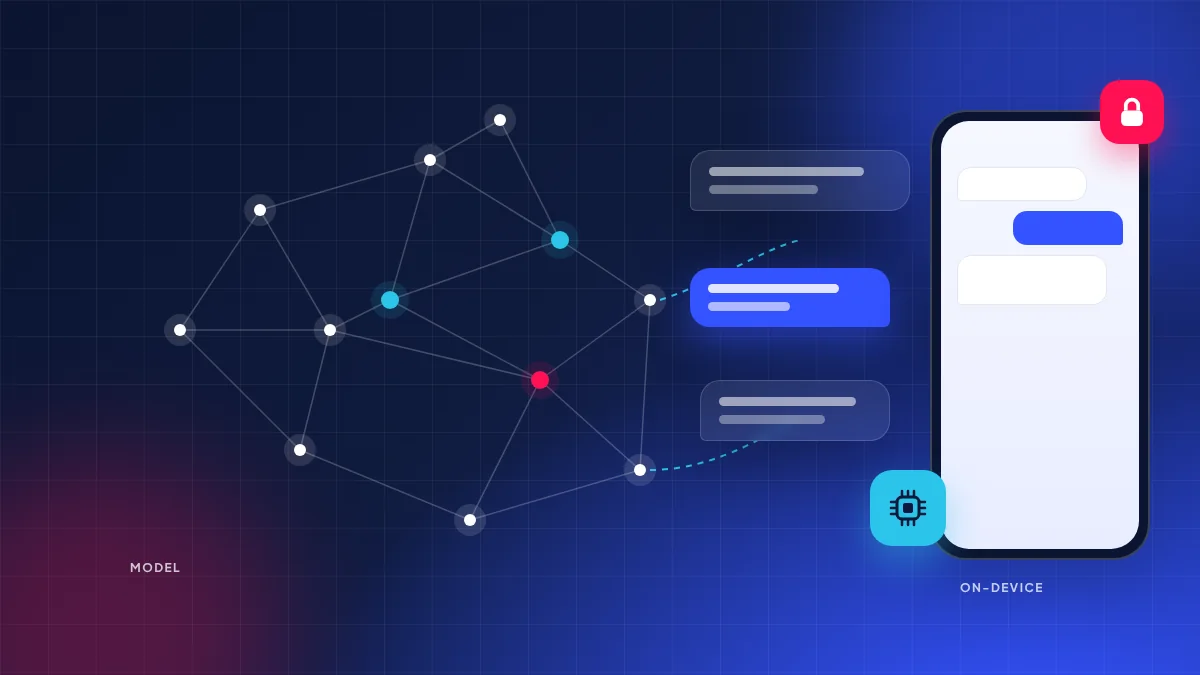
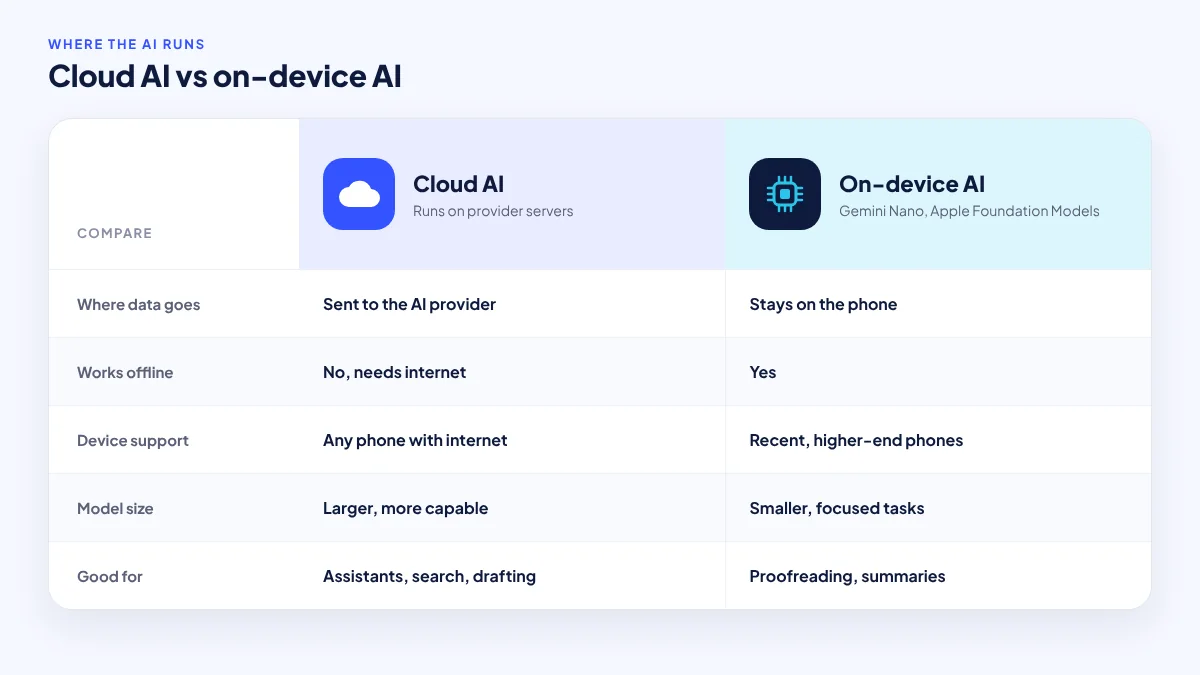
- Where the AI runs matters as much as what it does. Cloud AI sends data to a provider’s servers and returns a result. On-device AI runs on the user’s phone, works offline and keeps data local, but is smaller and less capable.
Most Philippine business use cases in 2026 involve generative AI running in the cloud, with on-device AI as an emerging option for specific features.
Six AI use cases that work for Philippine businesses
Based on what current tools can reliably do, these are the use cases ServicioPro considers realistic for SMEs today:
| Use case | Example | Where it usually runs | Human check needed? |
|---|---|---|---|
| Answer common questions from your own documents | Clinic hours, delivery areas, how to book | Cloud | Spot-check answers; hand off anything unclear |
| Search by description | “Waterproof bag for a 15-inch laptop” | Cloud with vector search | Low, since results link to real products |
| Summarise inquiries and reviews | One-line summary of a long quote request | Cloud or on-device | Staff read the original before replying |
| Draft product and social copy | First draft of a menu description | Cloud | Always review before publishing |
| Proofread and rewrite user text | Polishing a seller’s listing inside an app | On-device on supported phones | User approves the change |
| Describe images | Suggested alt text for uploaded photos | On-device or cloud | Review for accuracy |
Notice what is missing: AI that sets prices, approves refunds, gives medical or legal advice, or makes final decisions about customers. Those need accountable people and clear policies, not a language model.
Chatbots: what to expect and how to design one
Demand is real. According to Google, Temasek and Bain’s e-Conomy SEA 2025 report, as reported by NewsBytes.PH, 78% of Filipino digital users use AI tools. Many customers will happily type a question into a chat box.
Accuracy is the problem. In the Stack Overflow 2025 Developer Survey, 84% of developers said they use or plan to use AI tools and about 47% use them daily, yet only about 33% trust the accuracy of the output, while about 46% distrust it. If the people building with AI are cautious, a customer-facing bot needs guardrails.
A chatbot that works well for a Philippine SME usually has these traits:
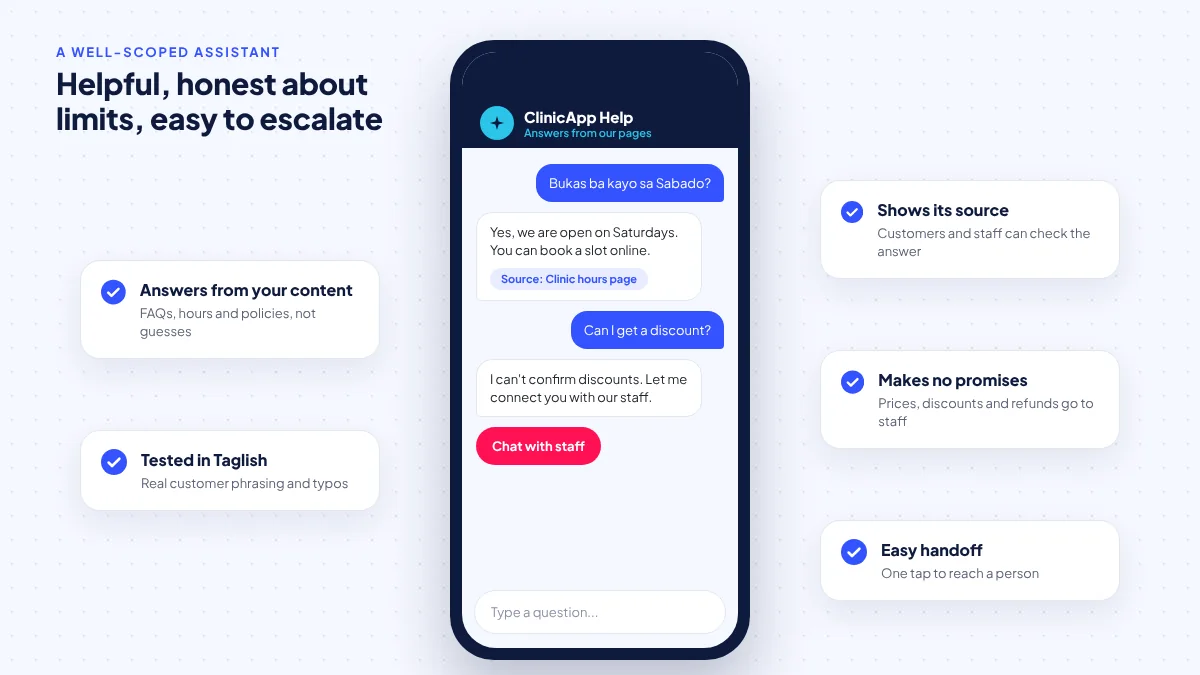
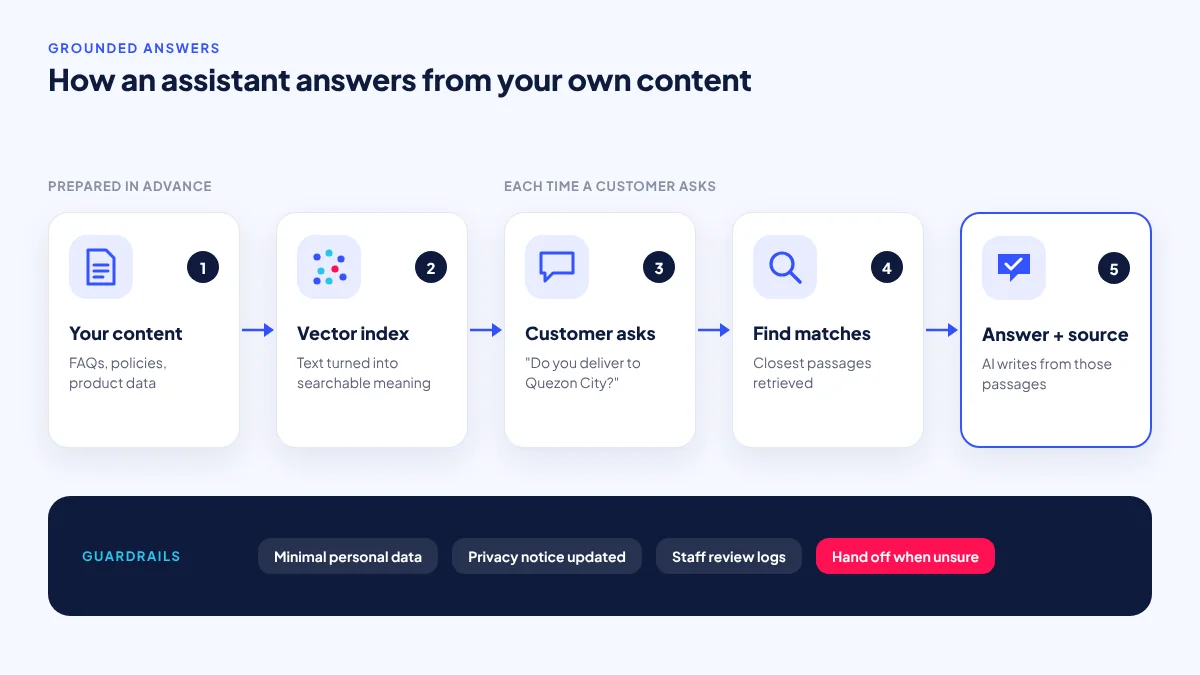
- Grounded in your content. It answers from your FAQ, service pages and policies, not from the model’s general knowledge.
- Honest about limits. When it does not know, it says so and offers a human channel such as Messenger, Viber, WhatsApp or a callback form.
- No commitments. It never confirms prices, discounts, refunds or availability unless that data comes live from your system.
- Tested in Taglish. Customers mix English and Filipino. Test real phrasing, spelling variations and short messages before launch.
- Logged and reviewed. Staff read a sample of conversations each week to catch wrong answers.
A chatbot is an add-on, not a substitute for clear basics. Our list of must-have business website features covers what should be on the page before any assistant is added.
On-device AI: Gemini Nano and Apple Foundation Models
Both mobile platforms now let apps run AI directly on the phone.
Android: ML Kit GenAI with Gemini Nano
Google’s ML Kit GenAI APIs, updated October 21, 2026, use Gemini Nano on the device for summarisation, proofreading, rewriting and image description, with a Prompt API in beta for more open-ended tasks. The catch: these features are limited to recent flagship phones, which are not what most Philippine customers carry.
iPhone: Apple’s Foundation Models framework
Apple announced its Foundation Models framework at WWDC25 on June 9, 2025, giving developers access to its on-device model, which works offline, as reported by TechCrunch. Two limits matter in the Philippines. First, Apple’s AI features require newer hardware; for example, iOS 27’s new Siri AI needs an iPhone 15 Pro or newer. Second, as reported by 9to5Mac, Apple Intelligence did not support Filipino as of iOS 26.1.
ServicioPro’s analysis: on-device AI is a good fit for privacy-sensitive helpers inside an app, such as tidying a note or summarising a long message, but only as an optional extra. Every feature built on it needs a fallback path for older phones, which in practice means either a cloud model or the same feature without AI. Since on-device features also work without a signal, they pair well with the ideas in our guide to offline-first resilience for Philippine apps.
Adding AI to web apps: Laravel 13’s AI SDK and vector search
For websites and web apps, the developer tooling caught up in 2026. According to the Laravel 13 release notes, the framework released on March 17, 2026 includes a first-party AI SDK and vector search support.
Vector search is the piece most businesses benefit from. It turns text, such as product descriptions or help articles, into numerical “embeddings” that capture meaning. A customer’s question is converted the same way, and the system finds the closest matches even when the words differ. Combined with a language model, this produces an assistant that answers from your own content and can cite which page it used. The general pattern is often called retrieval-augmented generation.
For business owners, the takeaway is that AI search and grounded assistants are now ordinary development work inside a well-maintained web app, not a research project. Our guide to Laravel 13 for business web applications covers the framework in more depth.
Privacy and security: settle these before you build
Any AI feature that processes names, phone numbers, addresses, health details or order histories is processing personal data under the Data Privacy Act (RA 10173). That brings obligations around notice, purpose, security and data sharing, including with the AI provider you send data to.
If personal data is compromised, the National Privacy Commission’s Circular 16-03 requires notification within 72 hours. Attackers are also using AI: the Verizon 2026 Data Breach Investigations Report estimated that about 15% of attack techniques were boosted by generative AI.
Our upcoming guide to Data Privacy Act compliance for websites and apps covers notices, consent and breach procedures.
What drives the cost of an AI feature
We have not found a credible published benchmark for AI feature costs in the Philippines, so we will not quote one. The cost depends on a few drivers:
- Usage fees. Cloud AI providers usually charge by volume of text processed, so cost grows with traffic and answer length.
- Data preparation. Clean, current FAQs and product data are the foundation. Messy content means more work and worse answers.
- Integration. Connecting AI to live stock, bookings or order status takes more work than a standalone chat box.
- Testing and review. Testing Taglish phrasing and reviewing logs is ongoing staff time.
- Fallbacks. On-device features need a second path for older phones.
The best first AI feature is the one that saves your staff an hour a day, not the one that looks most impressive in a demo.
A five-step plan for your first AI feature
- Pick one repetitive task, such as answering the same ten questions or sorting incoming inquiries.
- Clean up the source content the AI will rely on: FAQs, policies, product data.
- Build a small version with a human review step and a clear handoff to staff.
- Test with real customer phrasing, including Filipino, Taglish and typos, on the phones your customers use.
- Measure and decide: track time saved and wrong answers for a month before expanding.
Frequently asked questions
Can an AI chatbot replace my customer service staff?
Not reliably in 2026. A chatbot can handle repetitive questions and route the rest, but people still need to handle complaints, refunds, exceptions and anything involving money or safety.
Do AI features work in Filipino?
Support varies by model and platform. Apple Intelligence did not support Filipino as of iOS 26.1. Cloud models often handle Filipino and Taglish better, but you should test with real customer messages before launch.
Will on-device AI work for most of my customers?
Probably not yet. Google’s on-device GenAI features are limited to recent flagship phones, and Apple’s AI features need newer iPhones. Treat on-device AI as an extra with a fallback.
Is it legal to send customer data to an AI provider?
It can be, but the Data Privacy Act applies. You need a lawful basis, a clear privacy notice, appropriate security and suitable terms with the provider. Check with a lawyer or the NPC for your case.
Can AI be added to my existing website or app?
Often yes, if the site or app is on a maintained, supported platform. Old, unsupported systems usually need updating first, which is worth doing anyway for security.
Sources
Researched October 26, 2026. Dates show when each source was published.
- PH digital economy to hit $36B in 2025, leads SEA in AI adoption, NewsBytes.PH, November 26, 2025.
- 2025 Developer Survey: AI, Stack Overflow, 2025.
- ML Kit GenAI APIs, Google for Developers, updated October 21, 2026.
- Apple lets developers tap into its offline AI models, TechCrunch, June 9, 2025.
- iOS 26.1 brings Apple Intelligence to eight new languages, 9to5Mac, November 11, 2025.
- Apple announces iOS 27 release date, MacRumors, September 9, 2026.
- Laravel 13 Release Notes, Laravel, page consulted October 26, 2026.
- NPC Circular 16-03: Personal Data Breach Management, National Privacy Commission, 2016.
- 2026 Data Breach Investigations Report, Verizon, 2026.