10 min read
In 2026, the rules around mobile apps changed more than the apps themselves. Google Play now requires new apps and updates to target Android 16 (API 36), Android developer verification began in four countries with a global rollout planned for 2027, iOS 27 arrived on September 14, and both stores added new age-related tools. For Philippine businesses with an app, the urgent item is the Play target API deadline; the rest needs a plan, not panic.
This article collects the platform and store changes that affect business apps, such as ordering, booking, delivery, loyalty and ride apps, and separates what is already in force from what is still rolling out. Where something does not yet apply to the Philippines, we say so. All dates come from Google, Apple and reputable tech reporting, listed in the Sources section.
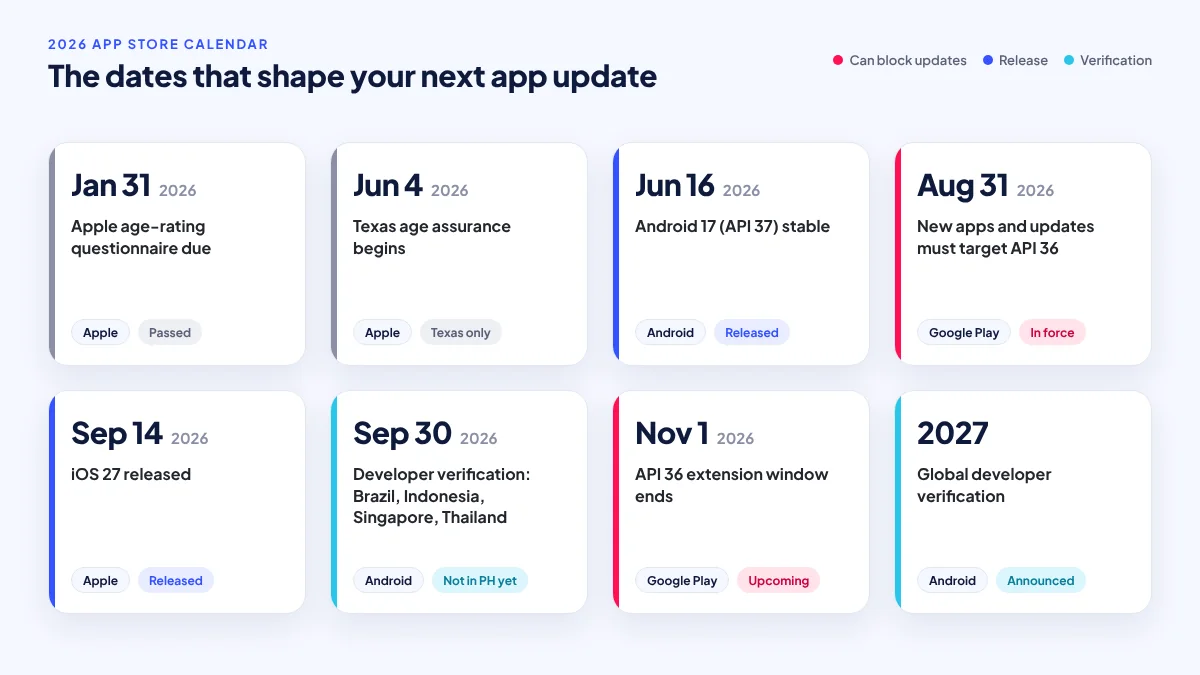
The 2026 app store calendar at a glance
Before the details, here is the year in one table. “Status” reflects what was true on October 26, 2026.
| Date | Change | Status for Philippine apps |
|---|---|---|
| January 31, 2026 | Deadline to answer Apple’s updated age-rating questionnaire | In force (passed) |
| June 4, 2026 | Apple age assurance requirements for Texas begin | Texas only |
| June 16, 2026 | Android 17 (API 37) stable release | Released |
| August 31, 2026 | Play: new apps and updates must target API 36 | In force |
| September 14, 2026 | iOS 27 released | Released |
| September 30, 2026 | Android developer verification enforced in Brazil, Indonesia, Singapore, Thailand | Not yet in the Philippines |
| November 1, 2026 | End of the extension window for the API 36 requirement | Upcoming |
| 2027 | Global developer verification | Announced |
Google Play’s API 36 requirement: the deadline that matters most
Every Android app declares a “target API level”, which tells Android which version’s rules and behaviours the app was built and tested for. Google raises the minimum each year so apps keep up with security and privacy changes.
According to Google Play’s target API requirements page, updated October 17, 2026:
- From August 31, 2026, new apps and app updates must target Android 16 (API level 36).
- Existing apps must target API level 35 or higher to remain available to new users on devices running newer Android versions.
- Developers who needed more time could request an extension to November 1, 2026.
In practice, an app that misses the requirement cannot ship updates, including urgent bug fixes and price or menu changes. For a delivery or booking business, that can freeze your app at the worst possible moment. If your app has not been updated since mid-2026, ask your developer today which API level it targets.
Raising the target is rarely a one-line change. Each Android version adjusts behaviour around permissions, background work, notifications and screen layouts, so the app must be retested on recent devices. Android 17 (API 37) was released as stable on June 16, 2026, according to 9to5Google, so testing should cover Android 16 and Android 17 phones.
Android developer verification: not here yet, but coming
Google is introducing developer verification for Android apps installed on certified Android devices, including apps installed outside Google Play. According to the Android Developers Blog (June 18, 2026) and Google’s developer verification pages:
- Enforcement started on September 30, 2026 in Brazil, Indonesia, Singapore and Thailand.
- Global enforcement is planned for 2027. The Philippines is not in the first wave.
- Apps distributed through Google Play must be registered.
- Limited-distribution accounts allow installation on up to 20 devices, aimed at students and hobbyists.
- Power users keep an ADB-based or “advanced” installation flow, which Android Authority reports includes a 24-hour wait.
Who in the Philippines should care now? Businesses that distribute APK files directly, for example a driver or rider app sent through messaging apps, an internal app for staff, or a field-sales tool installed by hand. When enforcement reaches the Philippines, those apps will need a verified developer identity. Planning the paperwork and accounts in 2026 avoids a rush in 2027. Our earlier post on Google Play’s contacts, location and developer verification policies covers the policy side in more depth.
iOS 27: what changed for business apps
Apple released iOS 27 on September 14, 2026. According to MacRumors, it supports iPhone 11 and newer, while the new Siri AI features require an iPhone 15 Pro or newer.
That split matters for planning. Your customers may all run iOS 27, but only those with newer, more expensive iPhones get the AI features. Any feature in your app that depends on Apple’s on-device AI should therefore have a fallback for older devices. Language is another limit: as reported by 9to5Mac, Apple Intelligence did not support Filipino as of iOS 26.1. Our guide to AI-powered websites and apps covers this in detail.
The usual iOS release routine still applies: rebuild with the current Xcode, test login, payments, push notifications and location permissions on the new version, and check any third-party SDKs for updates.
Age checks are becoming a platform feature
Both stores now give developers tools to adjust experiences by age, driven by laws outside the Philippines. These items are rolling out unevenly, so status matters.
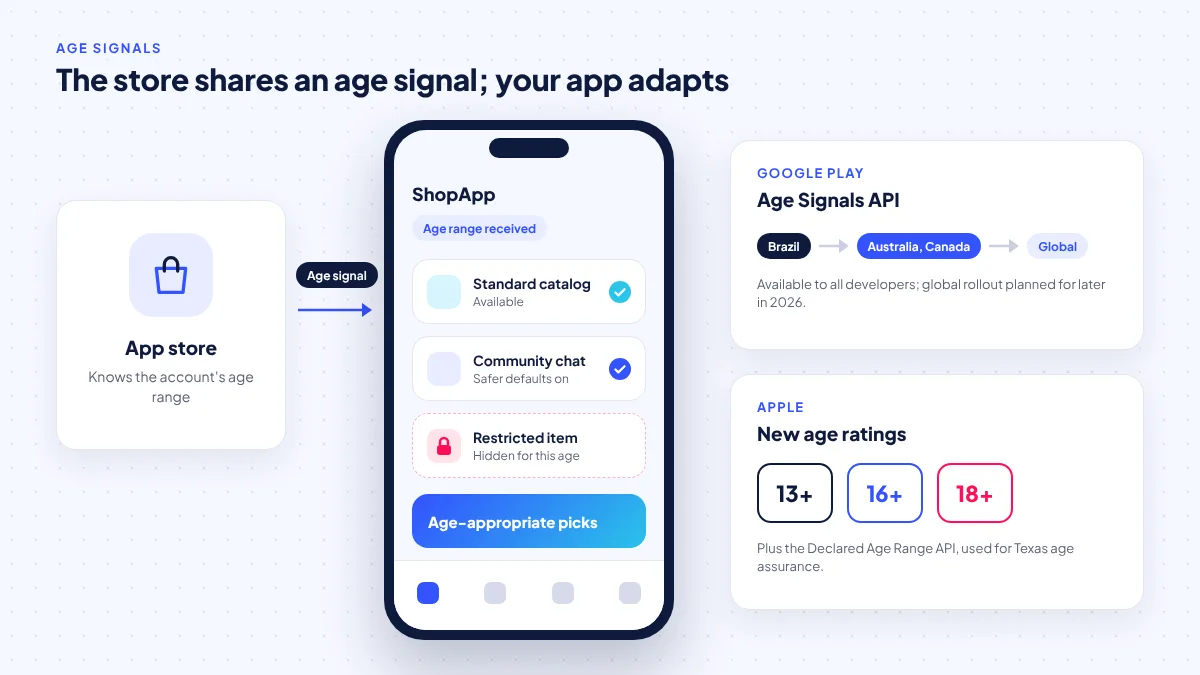
Google Play Age Signals API
According to the Android Developers Blog (July 29, 2026), the Play Age Signals API is available to all developers. Its rollout began in Brazil, extended to Australia and Canada in mid-August 2026, and is planned globally later in 2026. The API lets an app receive an age-related signal from Google Play and adapt content or features.
Apple’s new age ratings and Declared Age Range
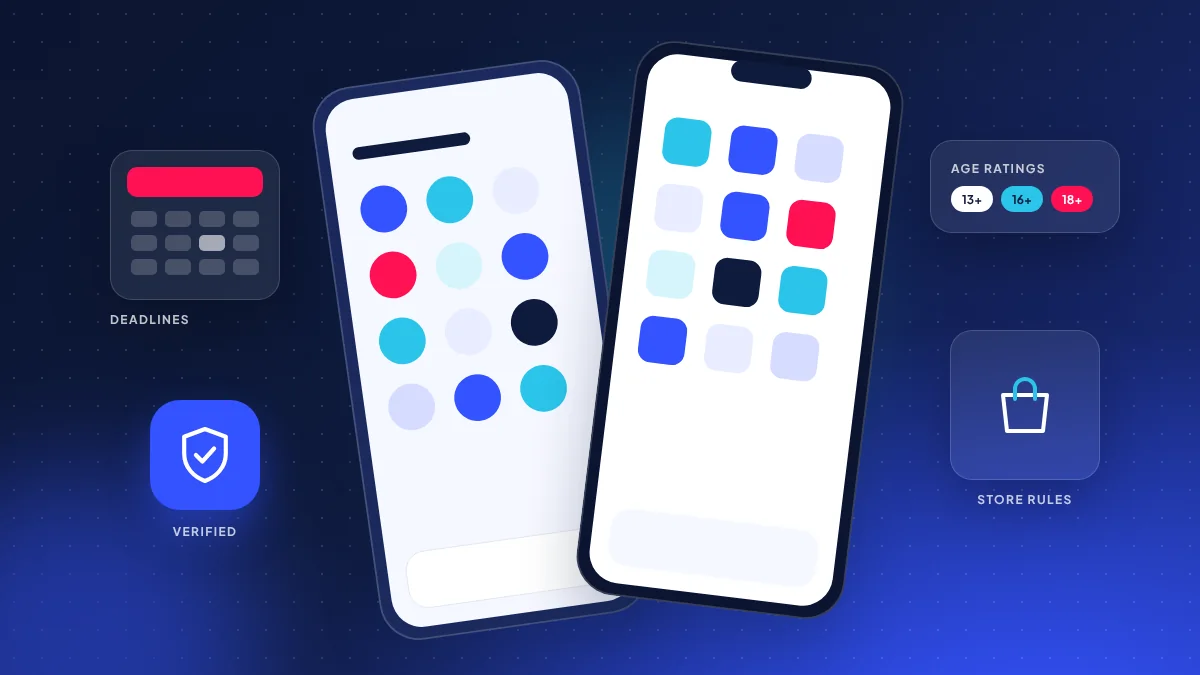
Apple introduced new 13+, 16+ and 18+ age ratings and asked developers to answer an updated age-rating questionnaire by January 31, 2026, as reported by 9to5Mac. Apple also announced age assurance requirements for Texas starting June 4, 2026, supported by its Declared Age Range API, according to Apple Developer News.
ServicioPro’s analysis: our research found no Philippine-specific app-store age mandate as of October 2026. Still, apps with chat, user-generated content or age-restricted products should review their age rating answers and keep an eye on the global Age Signals rollout.
Payments: external links remain a US story
Headlines about cheaper app store payments mostly do not apply here. Google Play’s alternative billing and external offer programmes covered the United States only, according to Google Play Console Help. Apple’s permission for external purchase links, published in May 2025, also applies to the US storefront.
For most Philippine business apps, this is less important than it sounds. Apps that sell physical goods or real-world services, such as food delivery, rides, bookings and retail orders, generally take payment through gateways supporting GCash, Maya, cards and bank transfers rather than store billing. Store billing rules mainly bite when you sell digital content or subscriptions inside the app. Our guides to the payment gateway stack for Philippine apps and accepting GCash and Maya cover the setup.
Cross-platform frameworks are keeping pace
If your app is built with Flutter, the framework itself needs regular updates. According to the Flutter release notes, the current stable line is 3.47, including a 3.47.8 security patch related to the eMudhra certificate authority, with Flutter 3.50 targeted for November 2026. Dart 3.13 was released on August 12, 2026.
Keeping the framework current is what makes API-level and iOS upgrades manageable. Apps left on old framework versions for years often need a large, risky jump when a store deadline arrives. Our Flutter vs React Native comparison covers framework choice, and our counterpoint article on when native still wins covers cases where cross-platform is the wrong fit.
An app is never finished. In 2026, a business app needs at least one planned update every year just to stay publishable.
What Philippine app owners should do now
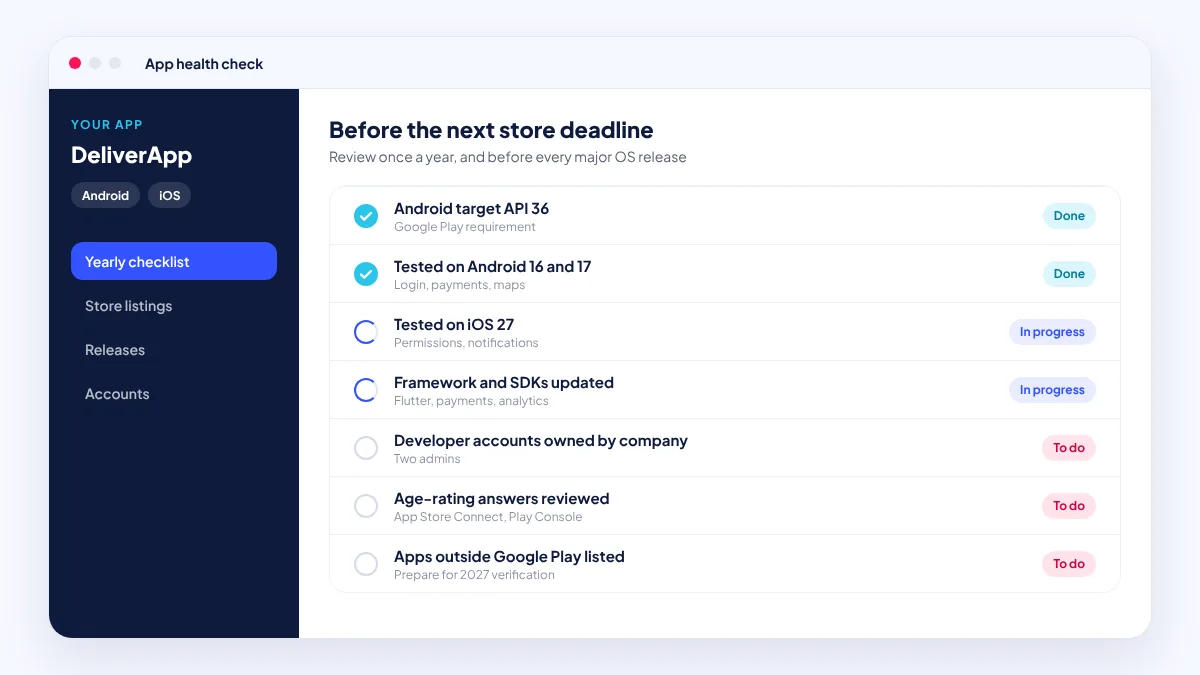
Here is ServicioPro’s recommended checklist, in order of urgency:
- Confirm your Android target API level. If it is below 36, schedule the upgrade immediately; the extension window ends November 1, 2026.
- Test on Android 16, Android 17 and iOS 27 devices, covering login, payments, notifications, maps and location permissions.
- Update your framework and SDKs (Flutter, React Native, payment, maps and analytics libraries).
- Check account ownership of your Google Play and Apple developer accounts.
- List any apps you distribute outside Google Play and prepare for developer verification in 2027.
- Review your age-rating answers in App Store Connect and your content rating in Play Console.
- Plan AI features with fallbacks for older phones and for Filipino-language users.
- Budget a yearly maintenance release so store deadlines never catch you unprepared.
Frequently asked questions
What happens if my Android app does not target API 36?
You will not be able to publish new versions of the app on Google Play until it targets API 36, unless you secured an extension, which runs only until November 1, 2026. Existing versions below API 35 may also become unavailable to new users on newer Android devices.
Does Android developer verification apply in the Philippines now?
Not yet. The first wave started on September 30, 2026 in Brazil, Indonesia, Singapore and Thailand, with global enforcement planned for 2027. Philippine businesses that install apps outside Google Play should prepare now.
Do I need to update my iPhone app for iOS 27?
Most apps keep working, but you should test on iOS 27 and rebuild with current tools. Problems usually appear in permissions, notifications or outdated third-party SDKs.
Can my Philippine app link users to cheaper payment options outside the store?
The external link and alternative billing programmes reported in 2025 cover the United States. Apps selling physical goods or services in the Philippines usually use payment gateways for GCash, Maya and cards already.
Is the Age Signals API mandatory?
Our research found no Philippine requirement to use it as of October 2026. It is available to all developers, and its global rollout is planned for later in 2026, so apps with user content or age-restricted products should evaluate it.
Sources
Researched October 26, 2026. Dates show when each source was published.
- Meet Google Play’s target API level requirement, Android Developers, updated October 17, 2026.
- Android developer verification update, Android Developers Blog, June 18, 2026.
- Android developer verification, Android Developers, page consulted October 26, 2026.
- Android sideloading changes timeline, Android Authority, page consulted October 26, 2026.
- Google Play Age Signals API, Android Developers Blog, July 29, 2026.
- Alternative billing and external offers programs (US), Google Play Console Help, October 29, 2025.
- Apple notifies developers of new App Store age rating system, 9to5Mac, July 24, 2025.
- App Store Review Guidelines update (US external purchase links), Apple Developer, May 2025.
- Age assurance requirements and Declared Age Range API, Apple Developer, 2026.
- Android 17 release schedule, 9to5Google, February 14, 2026.
- Apple announces iOS 27 release date, MacRumors, September 9, 2026.
- iOS 26.1 brings Apple Intelligence to eight new languages, 9to5Mac, November 11, 2025.
- Flutter release notes, Flutter, page consulted October 26, 2026.
- Dart blog (Dart 3.13), Dart, August 12, 2026.